Why Your Links Look Suspicious-And How to Fix It
Think about the last time someone sent you a link that looked like a small novel. You probably didn't read every character. You glanced at it, tried to figure out where it might lead, and then made a quick decision: click it, ignore it, or ask yourself, “What exactly is this?” That's the strange thing about URLs. Technically, they're just addresses. In practice, they're also part of the message you are sending. A clean, understandable link can feel intentional and familiar. A long string of parameters, numbers, and seemingly random characters can make even a perfectly legitimate destination look questionable.
- A Long URL Isn't Automatically a Bad URL
- People Don't Read URLs Like Developers Do
- Where Long Links Start Getting in the Way
- The Goal Isn't to Hide Where the Link Goes
- Where a URL Shortener Actually Helps
- Short Doesn't Automatically Mean Trustworthy
- Choose the Link Based on Where It Will Be Used
- A Better Rule for Sharing Links
That doesn't mean long URLs are bad. Far from it. Modern websites often use detailed URLs for perfectly sensible reasons, from organizing content and identifying products to measuring marketing campaigns. The problem isn't necessarily what's happening behind the link. It's what the person receiving it sees before they decide whether to interact with it.
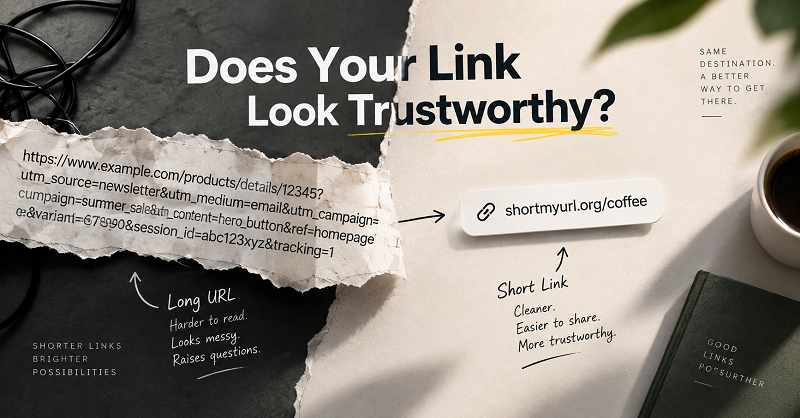
A Long URL Isn't Automatically a Bad URL
It's worth getting this out of the way first: URL length is not a reliable measure of whether a link is safe, useful, or trustworthy. A long address can belong to a completely legitimate website, while a short link can lead somewhere you would rather not visit. Treating length as a security signal would be a mistake.
Many URLs become lengthy because they contain useful information. An online store might include a product category and product name. A marketing team might add tracking parameters to understand where visitors came from. A web application might use identifiers to load a specific piece of content. None of these things are inherently suspicious.
The real issue is readability. When a URL becomes difficult to scan or understand, it can stop being helpful information and start looking like noise. That's particularly noticeable when you're sharing the link in a place where the URL itself is visible, such as an email, presentation, document, chat message, or printed material.
People Don't Read URLs Like Developers Do
Developers tend to look at a URL structurally. They can recognize a path, parameters, identifiers, and domains without thinking twice. Most people don't approach a link that way. They scan it.
When someone sees a link, they may only notice a few things: the domain, roughly what the destination appears to be, how long the address is, and whether it makes sense in the context of the message. A URL such as example.com/products/coffee-maker communicates something immediately. A long address filled with parameters and identifiers may communicate very little, even when both links ultimately point to the same page.
This is where the idea of link presentation becomes useful. You're not changing the content behind the URL. You're changing how easily another person can understand and handle the link before they use it.
Where Long Links Start Getting in the Way
On a website, a long URL usually doesn't matter much. Visitors click buttons, navigation elements, or text links without ever seeing the full address. Things change when you have to actually share the URL.
Email is a good example. Imagine sending a customer a carefully written message and finishing with a URL that stretches across multiple lines. The information may be perfectly valid, but visually it feels messy. If you're sending a newsletter, campaign, invitation, or business document, small details like this can affect how polished the communication feels.
Messaging creates a different problem. People copy and paste links constantly in group chats, direct messages, and support conversations. A long URL can dominate the message, push other information out of view, or simply become annoying to copy. Some platforms also generate previews, which means the visible URL may not even be the most useful part of the shared link.
Presentations and documents have their own headache. A long address can make a slide look cluttered, while a URL pasted into a report may wrap awkwardly across lines. If somebody has to manually type the address from a screen, the problem becomes even more obvious. One missing character is enough to send them somewhere else—or nowhere at all.
Then there is print. A long URL on a poster, flyer, business card, or event sign isn't merely unattractive; it's inconvenient. Asking someone to type a complicated web address from a piece of paper is a surprisingly effective way to make sure they never visit the page.
The Goal Isn't to Hide Where the Link Goes
Shortening a link should not be about disguising its destination. That's an important distinction.
A useful short link makes sharing easier while preserving a clear context for the person receiving it. If you're sending someone a link to a product page, tell them it's a product page. If you're sharing an event registration form, say what the form is for. The surrounding message still matters because a URL by itself rarely provides enough information to establish trust.
This is also why randomly shortening every link isn't necessarily a good idea. If a person receives an unexplained short URL from an unfamiliar source, they may have less information—not more—about what they're about to open. A shorter address can solve a presentation problem, but it cannot magically solve a trust problem.
Where a URL Shortener Actually Helps
This is where a url shortener can be genuinely useful. Instead of sharing a lengthy destination address, you can create a shorter version that is easier to copy, paste, remember, or place in a limited amount of space. The original destination remains the important part; the shortened link simply provides a cleaner way to reach it.
That can make a noticeable difference when you're sharing links across different environments. A short link can fit more comfortably into a message, look cleaner in a presentation, and be much more practical on printed materials. If the service also supports a custom alias, you may be able to make the ending more meaningful instead of relying on an arbitrary sequence of characters.
There's another practical benefit that often gets overlooked: less visual clutter means more attention on the actual message. If your goal is to tell someone why they should visit a page, you don't necessarily want half the screen occupied by an address they don't need to memorize.
Short Doesn't Automatically Mean Trustworthy
Here's the part worth remembering before you start shortening everything in sight: a short link isn't automatically a trustworthy link.
When you receive an unfamiliar shortened URL, context still matters. Who sent it? Why are they sending it? Does the surrounding message make sense? Is the domain recognizable? Does the link appear to be part of a legitimate campaign or conversation? If something feels unusual, don't let the fact that the URL is short convince you otherwise.
The same principle applies when you're creating links for other people. Avoid aliases that deliberately imitate another brand, make misleading claims, or obscure the nature of the destination. A memorable short link should make communication easier, not make the recipient guess what you're trying to show them.
In other words, there are two separate jobs here. Shortening improves usability. Context and transparency help establish trust. Good link sharing pays attention to both.
Choose the Link Based on Where It Will Be Used
There isn't one perfect URL format for every situation. If you're casually sending a page to a friend, the original URL may be completely fine. If you're sharing a campaign link with customers, a shorter and more recognizable address may look more deliberate. If you're putting a destination on a poster, combining a short URL with a QR code can give people two convenient ways to reach the same page.
The same thinking applies to marketing campaigns. A short link can make a campaign easier to identify and share, while analytics can provide useful information when the shortening service supports click tracking. But tracking shouldn't be added simply because you can. Only collect and use the information you actually need, and make sure your practices align with the applicable privacy requirements and the expectations of the people visiting your site.
For everyday sharing, the rule can be much simpler: if the original URL is already clear and easy to use, leave it alone. If it is unnecessarily long, awkward to share, or difficult to remember, shortening it may improve the experience.
A Better Rule for Sharing Links
There's a temptation to think of short URLs as automatically better URLs. That's too simplistic. The better question is not “Is this link short enough?” but “Does this link make sense for the person receiving it?”
A good link should be easy to share when it needs to be shared, clear enough to understand in context, and practical enough to use on the platform where it appears. Sometimes that means keeping the original URL. Sometimes it means using a url shortener to turn a cumbersome address into something much easier to work with.
The sweet spot is pretty simple: short enough to share, clear enough to trust, and useful enough to remember. That's a much better reason to shorten a link than simply trying to make a URL look smaller.