QR Codes, Printed Materials, and the Problem With Long URLs
A website URL is easy to click when you're sitting in front of a screen. Put that same URL on a poster across a room, a business card in someone's wallet, or a flyer sitting on a coffee shop counter, and things get a little more complicated.
- Why Long URLs Don't Work Well in Print
- QR Codes Solve Part of the Problem
- Why Put a Short URL Next to a QR Code?
- Short URLs Are Especially Useful for Printed Campaigns
- What About Tracking Offline Campaigns?
- The Short Link Doesn't Have to Be the Star
- Printed URLs Should Be Easy to Type
- QR Codes Don't Make Short URLs Obsolete
- What Happens When a Printed Campaign Needs to Change?
- Use Different Links for Different Offline Channels
- Keep the QR Code and URL Destination Consistent
- Don't Hide the Destination Completely
- When a Long URL Is Actually Fine
- A Practical Setup for Offline Marketing
- The Best Offline Link Is the One People Can Actually Use
This is one reason offline marketing has an interesting relationship with links.
You can use a QR code to send people directly to a webpage, but sometimes you still want a visible URL alongside it. Maybe someone doesn't want to scan the code. Maybe they're looking at the material from a distance. Or maybe the printed piece will be photographed and shared later.
That's where long URLs become a problem.
A short, readable link can make the offline-to-online experience much cleaner, while a QR code handles the quick scan.
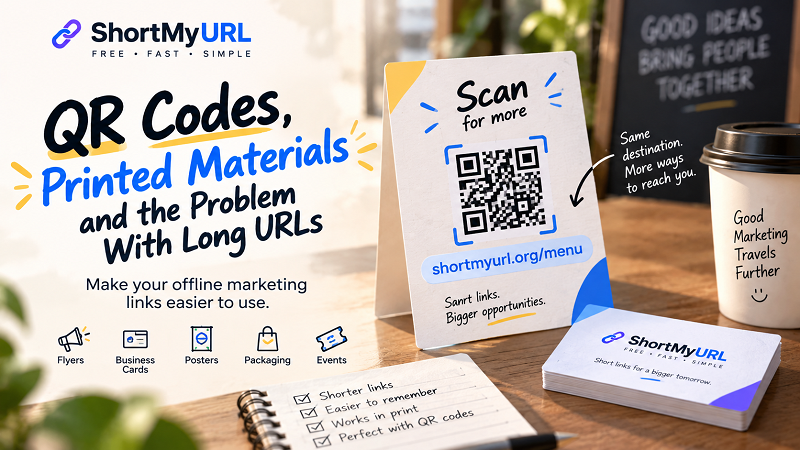
Why Long URLs Don't Work Well in Print
On a website, URL length usually isn't something people think about. You click a link, and you're done.
Printed materials are different.
Imagine putting this on a business card:
https://example.com/products/summer-collection/womens-shoes?utm_source=business-card&utm_medium=offline&utm_campaign=summer2026
It technically works. But asking someone to read, type, or remember it is another story.
Long URLs are harder to:
- Read at a glance
- Type manually
- Remember
- Copy from a photograph
- Fit neatly into a design
- Communicate verbally
And the longer the URL becomes, the more likely it is that someone will make a typo when entering it manually.
A printed campaign doesn't need to make the visitor work that hard.
QR Codes Solve Part of the Problem
QR codes have made it much easier to connect physical marketing materials with digital destinations.
A customer can point their phone at a code and open the corresponding webpage without typing anything.
That's incredibly convenient.
A restaurant can place a QR code on a table. An event organizer can put one on a poster. A retailer can add one to product packaging. A small business can put one on a business card.
The basic experience is simple:
See the code → Scan the code → Open the webpage.
But there's still a reason to consider the URL itself.
Not everyone wants to scan a QR code.
Some people may be using a device that isn't convenient for scanning. Others may simply prefer typing a web address. And in some situations, a visible URL provides useful context about where the QR code is going.
That's why QR codes and short URLs can work well together rather than being competing solutions.
Why Put a Short URL Next to a QR Code?
A QR code is great for speed.
A short URL is great for visibility.
Put them together, and you give people two ways to reach the same destination.
For example, a poster might display:
Scan to register
[QR CODE]
shortmyurl.org/register
The QR code gives smartphone users the fastest option.
The short link gives everyone else a visible fallback.
More importantly, a short link doesn't compete visually with the QR code. A compact URL can fit naturally into the design instead of taking up a large portion of the available space.
Short URLs Are Especially Useful for Printed Campaigns
Think about all the places where businesses put links offline.
Business cards. Flyers. Posters. Product packaging. Event signage. Brochures. Direct mail. Restaurant menus. Store displays. Conference materials.
These environments have something in common: space matters.
A designer might have only a small area available for a call to action.
Compare:
example.com/events/2026/fall-business-conference-registration
with:
shortmyurl.org/event
The second option is much easier to incorporate into a visual layout.
It can sit underneath a QR code, next to a call-to-action button, or inside a small promotional section without becoming the dominant element.
What About Tracking Offline Campaigns?
This is where things get particularly interesting for marketers.
Suppose you print 10,000 flyers promoting a product.
After the flyers are distributed, you want to know whether people actually visit the website.
You could use a QR code that points to a campaign URL containing tracking parameters.
For example:
https://example.com/product?utm_source=flyer&utm_medium=offline&utm_campaign=summer2026
Now you have a way to distinguish traffic from that campaign.
But again, the destination URL is long.
A short link can provide a cleaner public-facing address while directing visitors to the tracked destination.
This can also be useful when the campaign uses multiple physical channels.
For example, you could have different links for:
- Store flyers
- Business cards
- Event posters
- Magazine advertisements
- Product packaging
Each link can point to the appropriate destination or campaign URL, allowing the business to understand which offline placements generate activity.
The Short Link Doesn't Have to Be the Star
One mistake is trying to make the URL compete with the main message.
It doesn't need to.
On a poster, the primary message might be:
Join Our Fall Event
Then the QR code provides the obvious action.
Underneath it, a small line can say:
Can't scan? Visit: shortmyurl.org/event
That's enough.
The URL is there when someone needs it, but it doesn't distract from the campaign itself.
Good design often means knowing what not to emphasize.
Printed URLs Should Be Easy to Type
If you're putting a URL on something physical, assume that at least some people will type it manually.
That means readability matters.
Avoid unnecessary complexity when creating a public-facing short link.
A link such as:
shortmyurl.org/X7kP92
may be compact, but:
shortmyurl.org/menu
is easier to understand and remember.
If your URL shortener supports custom aliases, choose something that makes sense for the campaign.
Good aliases might include:
/menu
/event
/signup
/offer
/store
The exact choice depends on the campaign, but the principle is simple: make the link understandable without making it unnecessarily long.
QR Codes Don't Make Short URLs Obsolete
It can be tempting to think that QR codes have completely solved the problem of long URLs.
They haven't.
A QR code is essentially a visual representation of information. The person doesn't have to see or type the underlying URL.
But the URL still exists behind the code.
There are also practical reasons to have a human-readable link available.
For example, someone might see your poster on a laptop screen, encounter your flyer in a location where scanning isn't convenient, or save a photograph of the material for later.
A visible short URL gives that person another route.
It also makes the destination more apparent than a QR code alone.
What Happens When a Printed Campaign Needs to Change?
Here's a less obvious benefit of using a short link.
Printed materials are difficult to update.
Once you've printed thousands of flyers, you can't exactly log into the design software and change the URL.
But a short link can act as a stable entry point.
Imagine you've printed:
shortmyurl.org/event
The campaign initially sends visitors to a registration page.
Later, the registration system changes.
Instead of needing to replace every printed piece immediately, you can potentially update where the short link redirects, depending on how your URL management system works.
The printed URL stays the same.
The destination can change.
That's particularly useful for events, seasonal promotions, menus, campaigns, and other information that changes over time.
Use Different Links for Different Offline Channels
If you're running a larger campaign, using one identical link everywhere can make measurement more difficult.
Imagine you promote the same offer through a flyer, a business card, and a trade show banner.
Instead of using exactly the same link on all three, you could create separate short links:
shortmyurl.org/flyer
shortmyurl.org/card
shortmyurl.org/event
Each one can direct visitors toward the appropriate campaign destination or tracking setup.
Now the links themselves can tell you which physical channel they were created for.
This can make campaign organization much easier, especially when several people are distributing marketing materials.
Keep the QR Code and URL Destination Consistent
There is one rule that should never be overlooked:
Test everything before printing.
If your QR code points to one page while the visible short URL points somewhere else, you've created unnecessary confusion.
Before sending a design to the printer, scan the QR code and test the short URL.
Check that both lead to the intended destination.
Then test them again after the campaign goes live.
It's a small step, but fixing a bad URL on a printed poster after 5,000 copies have already been distributed is considerably less fun.
Don't Hide the Destination Completely
Shortening a URL makes it easier to share, but it can also hide some information about the final destination.
That's why context matters.
If you're promoting a business, event, or product, explain what people will find after they scan or visit the link.
For example:
View the full menu
[QR CODE]
shortmyurl.org/menu
is more informative than simply displaying:
Scan here
[QR CODE]
The user knows what they're being asked to access before taking action.
This is good practice for both QR codes and short links.
When a Long URL Is Actually Fine
Not every printed URL needs to be shortened.
If your website has a very simple address, there's no reason to complicate things.
For example:
example.com/menu
is already short and easy to remember.
There's little benefit in turning it into something else.
The same applies when the URL itself is part of your branding or when users specifically need to see the original domain and path.
The goal isn't to shorten links simply because you can.
It's to make the experience better when the original URL creates friction.
A Practical Setup for Offline Marketing
For a typical printed campaign, the setup can be surprisingly simple.
Start with the webpage you want visitors to reach.
Add campaign tracking if you need to measure traffic from that specific offline campaign.
Create a short link that redirects to the destination.
Generate a QR code using that link.
Then place both the QR code and the short URL into your printed design.
Before printing, test the QR code and the short link on multiple devices.
Once everything works, you're ready to go.
This gives people a fast scanning option while keeping a simple, memorable URL available as a backup.
The Best Offline Link Is the One People Can Actually Use
Offline marketing has one major limitation that digital marketing doesn't: you can't click a piece of paper.
Every extra step matters.
A complicated URL asks people to read more, type more, and remember more. A QR code removes much of that friction, while a short URL provides a clean alternative for people who prefer a visible link.
Together, they create a simple bridge between the physical and digital worlds.
If you're preparing a flyer, poster, business card, event banner, or another printed campaign, take a look at the URL you're planning to display. If it's already short and readable, you're probably fine.
If it looks like a wall of tracking parameters, that's a different story.
A short url can give your printed campaign a cleaner, more practical destination while a QR code handles the instant mobile experience.
The technology behind it may be simple, but the result is useful: less friction between seeing your campaign and actually reaching it.