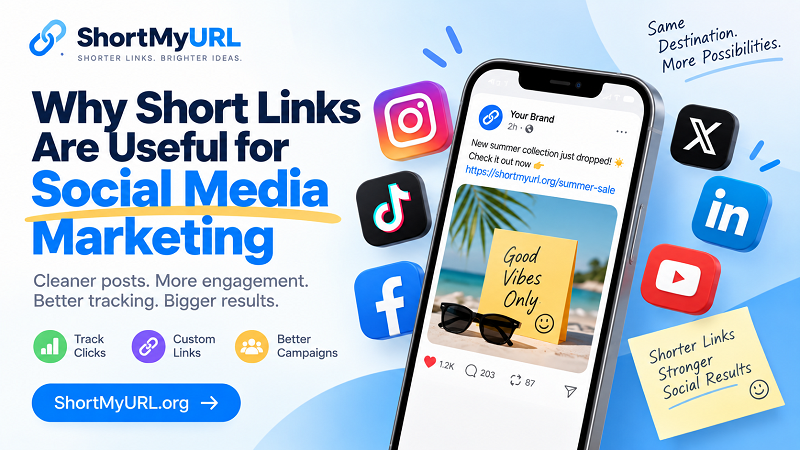
Why Short Links Are Useful for Social Media Marketing
Social media moves fast. People scroll quickly, skim even faster, and rarely have the patience to deal with a giant, ugly URL stuffed with random characters. That's one reason short links have become a useful little tool for social media marketers.
- Social Media Is About Attention, Not URLs
- 1. Short Links Keep Social Posts Cleaner
- 2. They Give You More Room for the Actual Message
- 3. Short Links Are Useful for Campaigns
- 4. Track Clicks Instead of Guessing
- 5. Create Different Links for Different Campaigns
- 6. Custom Aliases Can Make Campaign Links Memorable
- 7. Short Links Can Work Well With Influencer Campaigns
- 8. Short Links Are Handy for Social Media Graphics
- 9. Don't Shorten Links Just for the Sake of It
- 10. Short Links Can Make Your Workflow Less Messy
- Short Links Are a Small Tool With a Useful Job
A short link can make a post look cleaner, give you more room for your actual message, and, when tracking is available, help you understand what happens after someone clicks. But there's more to it than simply making a URL shorter. Let's look at where short links actually fit into social media marketing.
Social Media Is About Attention, Not URLs
When someone sees your post, the URL usually isn't the reason they stopped scrolling. They're looking at the headline, image, video, offer, or first sentence. The link is there to move them somewhere else.
That's why an unnecessarily long URL can be a distraction. Imagine a promotional post containing a URL like this:
https://example.com/products/summer-collection/womens/shoes?color=white&size=8&utm_source=instagram&utm_medium=social&utm_campaign=summer2026
It may contain useful tracking information, but visually? It's a lot.
A shorter link can keep the focus where it belongs: on your content.
1. Short Links Keep Social Posts Cleaner
Social media posts already have plenty going on. You might have a headline, product description, emojis, hashtags, a call to action, an image or video, and a link. Adding a huge URL on top of all that can make the post feel cluttered.
A short link takes up much less visual space. Instead of letting the URL dominate the post, you can keep the message focused on what you actually want people to do.
See the offer → Short link.
That's much easier on the eyes.
2. They Give You More Room for the Actual Message
On platforms where every character or line matters, unnecessary URL length can be annoying. A shorter link means more space for the stuff people actually care about.
For example:
New summer collection just dropped. Check it out: [short link]
feels a lot more natural than:
New summer collection just dropped. Check it out: [long URL with multiple parameters and tracking codes]
The difference might seem small. Across dozens or hundreds of posts, it adds up.
3. Short Links Are Useful for Campaigns
This is where things get more interesting. Let's say you're promoting the same landing page across several channels: Instagram, Facebook, LinkedIn, X, email, and online communities.
You could use the exact same destination URL everywhere. But campaign tracking can become much more useful when you can distinguish where your traffic comes from.
A URL shortener with analytics can help you monitor clicks on the links you create. For example, you might create separate short links for different campaigns or channels. That gives you a much cleaner way to organize your links while keeping the destination the same.
If you're looking for a simple way to create and manage short links, you can use the free URL shortener from ShortMyURL: https://shortmyurl.org/
4. Track Clicks Instead of Guessing
Likes are nice. Comments are nice. Shares are nice. But sometimes you really want to know one thing: Did people click the link?
That's where link analytics can become useful. Depending on the URL shortener you're using, analytics may provide information such as click activity and other basic performance data.
That can help answer questions like:
• Which campaign generated more clicks?
• Did people actually visit the page?
• Which social post drove traffic?
• Did a promotional link get any attention?
• Is a particular campaign worth repeating?
Instead of relying entirely on likes or impressions, you get another piece of the puzzle.
5. Create Different Links for Different Campaigns
Here's a simple marketing workflow. Imagine you're promoting one product on three platforms. Instead of sharing one short link everywhere, you could create separate links for each campaign.
Instagram: short-link / instagram
Facebook: short-link / facebook
LinkedIn: short-link / linkedin
All three can point to the same landing page. Now you have a much cleaner way to distinguish your campaigns. This can be particularly useful when you're running multiple promotions at the same time.
6. Custom Aliases Can Make Campaign Links Memorable
Random short URLs work. But sometimes you want something people can actually recognize.
Compare:
shortmyurl.org/a8Kx91
with:
shortmyurl.org/summer-sale
The second one immediately tells you what the link is associated with.
Custom aliases can be useful for promotions, events, giveaways, special offers, content campaigns, and product launches. A memorable short link can also be easier to communicate outside the social platform itself.
Someone can see it on a graphic, hear it in a video, or remember it after seeing it in a post.
7. Short Links Can Work Well With Influencer Campaigns
Influencer marketing often involves multiple creators sharing the same campaign. That creates an interesting tracking problem. If everyone uses the exact same destination URL, separating campaign activity can become more difficult.
Short links can provide a practical way to give different creators or campaigns their own links. For example, Creator A can use campaign link A, Creator B can use campaign link B, and Creator C can use campaign link C.
The destination can remain the same while the links themselves are different. With click analytics, you can then review the activity associated with each link.
It's a simple concept, but it can make campaign organization much easier.
8. Short Links Are Handy for Social Media Graphics
Not every social media campaign lives entirely inside a clickable post. Sometimes the link appears in images, videos, stories, presentations, promotional graphics, or digital flyers.
In those situations, a short URL is much easier to display than a long one. A designer can place shortmyurl.org/sale on a graphic without sacrificing half the available space to a URL.
And if someone needs to type the address manually, a short link is much less painful.
9. Don't Shorten Links Just for the Sake of It
Short links aren't automatically better in every situation. If a platform already provides a clean clickable button or automatically handles your URL nicely, shortening may not add much value.
Likewise, if the full URL contains information that your audience actually needs to see, hiding it may be counterproductive.
The better approach is simple: use short links when they solve a real problem.
If they make your campaign cleaner, easier to remember, easier to share, or easier to track, they're worth using. If they don't, don't force them.
10. Short Links Can Make Your Workflow Less Messy
Here's the underrated benefit. It's not just about what your audience sees. It's also about what you have to manage.
A social media manager might have dozens of campaigns running at once. There are product launches, seasonal promotions, paid campaigns, influencer posts, giveaways, blog posts, and events.
Having shorter, recognizable links can make that collection of URLs easier to organize. Instead of looking at a spreadsheet full of enormous URLs, you might have a list of simple campaign links that are immediately recognizable.
Less chaos. More control.
Short Links Are a Small Tool With a Useful Job
Short links aren't going to magically turn a bad social media campaign into a successful one. Your content still matters. Your offer matters. Your audience matters. Your strategy matters.
But good marketing is often about removing little points of friction. A shorter URL can make a post cleaner. A custom alias can make a campaign easier to remember. Click tracking can give you another way to measure performance. And separate campaign links can make your marketing workflow easier to manage.
That's why short links continue to have a place in social media marketing. They're small, simple, and surprisingly useful.
If you want to create a clean link for your next social campaign, try ShortMyURL's free URL shortener at https://shortmyurl.org/ and turn your next long URL into a link that's ready to share.