How to Share Long Links Without Making Your Message Look Messy
We've all been there. You find a page you want to share, copy the URL, paste it into a message—and suddenly half the screen is filled with a string of letters, numbers, symbols, and tracking parameters.
- Why Do Some URLs Get So Long?
- A Short Link Can Make Sharing Much Cleaner
- Why Long Links Can Be Annoying in Messages
- Text Messages Are a Perfect Example
- Email Can Get Messy Too
- Social Media Is Another Place Where Short Links Make Sense
- What About Printed Materials?
- A Memorable Link Can Be Even Better
- Short Links Can Also Help You Understand Clicks
- Should You Shorten Every URL?
- Keep the Link Short, But Keep It Trustworthy
- A Cleaner Way to Share Links
The link works perfectly. That's not the problem. The problem is that it looks terrible.
Long URLs are simply part of how the modern web works. A single link might contain information about a product, category, search filter, campaign, language, or tracking source. That's useful for websites and marketers, but not necessarily useful to the person receiving the link.
Fortunately, there are several simple ways to make links easier to share without changing where they lead.
Why Do Some URLs Get So Long?
A basic website address can be surprisingly short. For example, https://example.com/about doesn't have much going on.
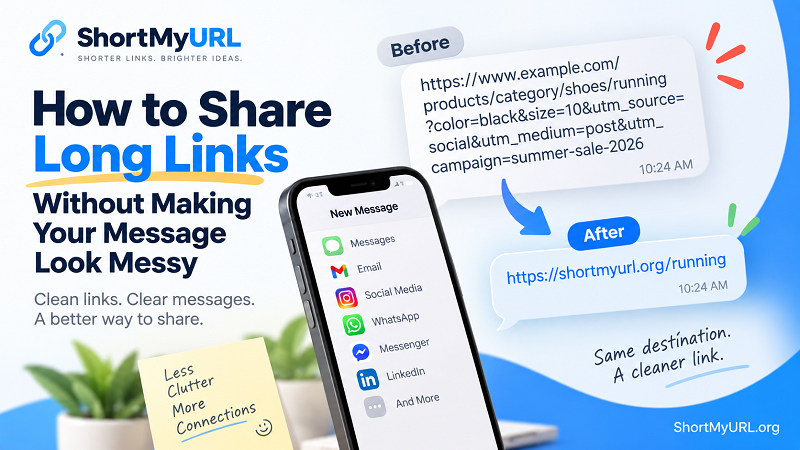
But things change when you start visiting product pages, search results, campaign landing pages, or other dynamically generated content. You might encounter something like https://example.com/products/category/shoes/running?color=black&size=10&utm_source=social&utm_medium=post&utm_campaign=summer-sale.
That URL may contain valuable information for the website owner. Tracking parameters can help identify where visitors came from, while other parts of the address may tell the website exactly which page or product should be displayed.
For the person you're sending it to, though, most of that information is unnecessary. They just want the page. And when you're sharing a link in a text message, email, social media post, or chat, a shorter version can be much easier to deal with.
A Short Link Can Make Sharing Much Cleaner
The most straightforward solution is to turn a long URL into a short link. Instead of sending someone a complicated address, you can create a compact link that redirects them to the same destination.
For example, a long URL like https://example.com/products/category/shoes/running?color=black&size=10&utm_source=social&utm_campaign=summer-sale can become something much simpler, such as https://shortmyurl.org/running.
The destination can remain the same. The difference is what the person sees and has to work with.
If you regularly share long URLs, you can use the free URL shortener from ShortMyURL to create a cleaner link in just a few seconds.
Why Long Links Can Be Annoying in Messages
A long URL isn't necessarily harmful, but it can make an otherwise simple message feel unnecessarily complicated.
Consider this: “Hey, check out this article: https://example.com/blog/marketing/social-media/how-to-create-a-content-strategy-for-small-businesses?utm_source=facebook&utm_medium=social&utm_campaign=content.” Now compare it with: “Hey, check out this article: https://shortmyurl.org/content-guide.”
The second message gets to the point much faster. This matters even more on mobile devices, where long links can wrap across several lines and push the actual message out of view.
When you're sending a link to a friend, customer, coworker, or social media audience, the link should support your message—not become the message.
Text Messages Are a Perfect Example
Think about how often links are shared through messaging apps. You might send someone a product you found, an article you enjoyed, a restaurant page, an event registration form, or a video.
Most of the time, the person doesn't care what all those characters in the URL mean. They just want to tap the link.
A short URL makes the message easier to scan and gives the conversation a cleaner appearance. It's a small difference, but small differences are often what make digital communication feel effortless.
Email Can Get Messy Too
Email has the same problem, particularly when you're working with plain-text messages or sharing URLs directly.
A long address can wrap onto multiple lines, become difficult to copy, or simply overwhelm an otherwise clean email. Of course, you can often hide a URL behind descriptive text such as “Read the full article” or “View the product.” That's usually a great option when you're writing HTML email.
But sometimes you actually want the URL to be visible. That's when a short link can come in handy.
A compact URL is easier to recognize, copy, and share while still showing the recipient that they're looking at a link.
Social Media Is Another Place Where Short Links Make Sense
Social media posts already compete for attention. You've got the headline, the image or video, the caption, hashtags, calls to action, and everything else happening on the screen.
Dropping a giant URL into the middle of that can make the post look unnecessarily busy.
A short link gives you a cleaner alternative. It can be particularly useful when you're sharing blog posts, product pages, promotions, signup pages, event registrations, or campaign landing pages.
The goal isn't to make the URL the most noticeable part of your post. Quite the opposite. You want people to notice your content first.
What About Printed Materials?
Here's where short links become even more practical. Online, people can simply tap a link. On a poster or flyer, they can't.
If someone needs to manually type a URL from a business card, printed advertisement, product package, event sign, or flyer, every extra character creates another opportunity for a typo.
Compare example.com/events/2026/summer-community-event/registration with shortmyurl.org/summer. The second one is much easier to remember and type.
That's one reason short, memorable links can still be useful even in a world where most links are clicked rather than typed.
A Memorable Link Can Be Even Better
Not all short URLs have to look like a random collection of characters. Some URL shorteners allow you to create a custom alias.
For example, shortmyurl.org/x7K92a is functional, but shortmyurl.org/summer-sale is easier to understand.
A custom alias can tell people something about the destination before they click. It can also make a campaign easier to remember and easier to mention in a conversation.
This can be especially useful for promotions, events, product launches, giveaways, and other campaigns where the link itself is part of the communication.
Short Links Can Also Help You Understand Clicks
There's another reason businesses and marketers use short links: analytics.
If the shortening service provides click tracking, you can get a better idea of how people interact with the links you're sharing.
For example, you might want to know whether a campaign is actually generating clicks rather than simply collecting likes or impressions. You could create different short links for different campaigns, channels, or promotions and then review their click activity.
That turns a simple URL into a small piece of useful marketing data. It's not a replacement for a complete analytics platform, but it can give you another useful signal about how your links are performing.
Should You Shorten Every URL?
No. And that's worth saying. URL shortening isn't something you need to use every time you share a link.
If you're sending someone a simple address like https://example.com/contact, there's probably no reason to shorten it. Likewise, if the full URL contains information that your audience needs to see, keeping it visible may actually be preferable.
The point isn't to make every URL shorter. The point is to make links easier to use when the original URL gets in the way.
Keep the Link Short, But Keep It Trustworthy
There's one other thing to consider when sharing shortened URLs: trust.
A short link hides the original destination, so people may be more cautious about clicking an unfamiliar link. That's why context matters.
If you're sharing a link with customers or an audience that doesn't know you, make it clear where the link is taking them whenever possible. A recognizable service and a meaningful custom alias can also make a short link feel more transparent.
Shortening a URL should make sharing easier—not make people wonder where the link goes.
A Cleaner Way to Share Links
Long URLs aren't going anywhere. Websites need them for all kinds of reasons, and the information inside them can be useful.
But the person you're sending a link to doesn't always need to see all of it. Sometimes, they just need a simple path to the page you're talking about.
That's where short links fit in.
They can make messages cleaner, social posts less cluttered, printed materials easier to read, and campaign links easier to organize. With custom aliases and click tracking, they can also become useful tools for marketing and link management.
So the next time you copy a URL and realize you've just pasted half the internet into your message, don't overthink it. Shorten it.
Your recipient will probably appreciate the cleanup.
If you need a quick way to turn a long URL into a clean, shareable link, try the free URL shortener from ShortMyURL.