QR Codes and Short Links: How They Work Better Together
QR codes are everywhere these days. You'll find them on restaurant menus, product packaging, posters, business cards, event tickets, retail displays, and just about anything else that needs to connect the physical world to the internet.
- What Actually Happens When You Scan a QR Code?
- Why Put a Short Link Behind a QR Code?
- Short Links Give Printed Campaigns Another Layer of Control
- QR Codes and Click Tracking Can Work Together
- One Landing Page, Multiple QR Codes
- Short Links Can Make QR Codes More Flexible
- QR Codes Are Great Offline. Short Links Work Everywhere.
- Custom Short Links Can Make Offline Campaigns More Memorable
- Where Can You Use QR Codes With Short Links?
- Don't Forget to Test Before You Print
- A Simple QR Code Campaign Setup
- The QR Code Is Just the Beginning
- QR Codes + Short Links = A Smarter Offline-to-Online Journey
The concept is beautifully simple. Scan a code with your phone, tap the notification, and you're online.
But there's an important piece hiding behind that little square of pixels: the URL.
Every QR code that sends someone to a website needs a destination, and the way that destination is set up can make a difference when you're running a marketing campaign. In many situations, pairing a QR code with a short link can make the whole experience easier to manage, share, and track.
Here's how the two work together.
What Actually Happens When You Scan a QR Code?
A QR code doesn't magically contain a website. It contains encoded information that your phone can read. When that information is a URL, your phone recognizes the web address and gives you the option to open it in your browser.
For example, a QR code might point directly to example.com/products/summer-collection. Someone scans it, the browser opens the page, and that's the end of the story.
But URLs can get much longer when they're connected to campaigns, product filters, tracking parameters, or other website functionality. You could end up with something like example.com/products/summer-collection?utm_source=poster&utm_medium=offline&utm_campaign=summer2026.
That link can work perfectly well, but there may be a more flexible way to build the campaign. Instead of encoding the final destination directly into the QR code, you can have the QR code point to a short URL. The short URL then redirects the visitor to the intended page.
The basic journey becomes simple: QR code → short link → destination page.
Why Put a Short Link Behind a QR Code?
At first, this might sound like an unnecessary extra step. If the QR code can point directly to the final page, why add a short link?
For a simple personal QR code, you may not need one at all. But things change when that QR code becomes part of a marketing campaign.
Imagine you've just printed 5,000 promotional flyers. Each flyer contains a QR code that sends customers to your summer promotion. A few days after printing, you realize the campaign page needs to change.
If the QR code points directly to the final destination, changing that destination can be difficult. You may need to create a new QR code and replace the printed material.
If the QR code points to a short link, the short link can act as an intermediate destination between the QR code and your website. If your URL shortening service allows existing links to be edited, you may be able to change where the short link sends visitors without changing the QR code itself.
That flexibility can be extremely useful for campaigns that live on printed materials for weeks or months.
Short Links Give Printed Campaigns Another Layer of Control
Printed marketing has one major disadvantage compared with digital content: once it's printed, it's printed.
You can edit a social media post. You can update a website. You can change an email campaign before it goes out. A stack of 10,000 flyers sitting in a warehouse isn't quite as flexible.
That's why it's worth thinking carefully about the link behind a QR code before sending a design to the printer.
A setup like poster → QR code → short link → landing page gives you an additional layer between your physical marketing material and the final destination. If the campaign changes later, that middle layer may give you more options than a QR code pointing directly to a fixed page.
Of course, this depends on the capabilities of the URL shortener you're using. Not every service allows destinations to be changed after a link has been created, so that's something to check before launching an important campaign.
QR Codes and Click Tracking Can Work Together
There's another reason marketers may want to use short links with QR codes: analytics.
A QR code by itself isn't necessarily a complete analytics system. What matters is what happens after someone scans it and visits the destination.
If the QR code points to a short link that supports click tracking, you may be able to collect useful information about activity on that link. That can help answer practical questions such as whether a poster generated traffic, whether an event flyer attracted visitors, or whether a particular promotion got people to visit the landing page.
This becomes particularly useful when you're comparing different offline campaigns.
For example, imagine you're promoting the same product with a poster and a printed flyer. Both can send people to the same landing page, but each piece of marketing can have its own short link. That gives you a way to distinguish the activity associated with each campaign.
Instead of simply knowing that people visited your website, you may be able to get a better idea of which campaign brought them there.
One Landing Page, Multiple QR Codes
This is where the combination becomes especially useful for marketers.
Imagine you're promoting a new product through three offline channels: store posters, business cards, and event flyers. All three need to send visitors to the same product page.
You could create separate short links for each campaign, such as shortmyurl.org/poster, shortmyurl.org/card, and shortmyurl.org/event, with each one pointing to the same destination.
Then you can generate a QR code for each short link.
The result is straightforward: three different campaign entry points, one destination, and a much clearer way to organize the links.
This approach can be useful when you're running multiple campaigns at the same time and want to keep their traffic separate.
Short Links Can Make QR Codes More Flexible
There's a common misconception that a short URL automatically means a much smaller QR code.
It's a little more complicated than that.
The physical size and complexity of a QR code depend on several factors, including how much information is encoded, the QR version, error correction level, printing quality, and scanning conditions.
So you shouldn't use a short link simply because you expect it to magically turn a huge QR code into a tiny one.
The more important advantage is flexibility.
A shorter URL contains less data than a long URL, which can contribute to a simpler QR code structure. More importantly, the short link gives you a useful layer for managing the destination, organizing campaigns, and potentially tracking activity.
In other words, shorten the URL because it makes the campaign better—not just because you want a smaller-looking QR code.
QR Codes Are Great Offline. Short Links Work Everywhere.
One of the best things about combining the two is that the short link doesn't stop being useful once the QR code is created.
You can print the short URL underneath the QR code, mention it in a video, share it on social media, include it in an email, or give it to someone directly.
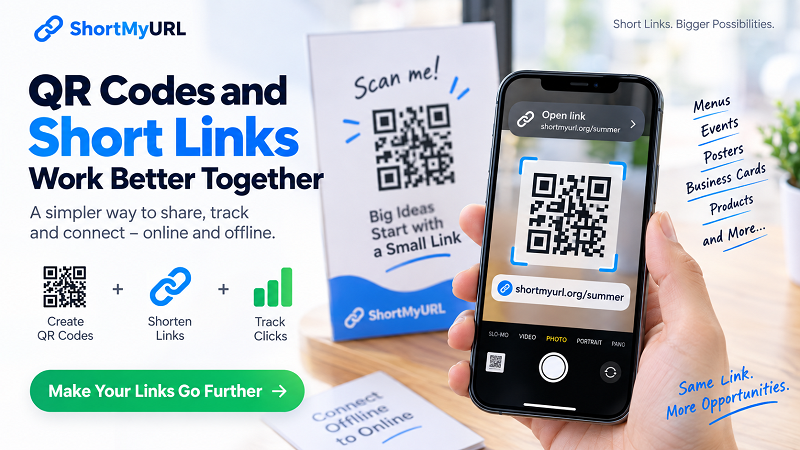
For example, a poster could say: “Scan the QR code or visit shortmyurl.org/summer.”
That's useful when someone can't scan the code. Maybe they're standing too far away from the poster, their camera isn't cooperating, or they're viewing the campaign from a desktop computer. Whatever the reason, the short URL gives them another way to reach the same destination.
That's a small detail, but it's a nice backup to have.
Custom Short Links Can Make Offline Campaigns More Memorable
Not all short links have to look like random collections of characters.
If your URL shortener supports custom aliases, you can create something more recognizable. A random address might look like shortmyurl.org/a7K92x, while a campaign-specific address could look like shortmyurl.org/summer.
The second option immediately gives the link some context.
That's especially useful when the short URL is printed next to a QR code. Someone might not scan the code immediately, but they may remember the short address and type it later.
A memorable alias can also make a campaign easier to discuss. Saying “Go to shortmyurl.org/summer” is much easier than trying to communicate a random string of characters.
Where Can You Use QR Codes With Short Links?
The possibilities go well beyond restaurant menus.
Businesses can use QR codes and short links on product packaging to send customers to product information, instructions, registration pages, or promotional content. A business card can use them to connect people with a website, portfolio, booking page, or contact page. Events can use them for registration, schedules, maps, and additional resources.
The same approach works for posters, flyers, retail displays, printed advertisements, menus, packaging, and other physical materials.
The basic idea remains the same: physical material → QR code → short link → online destination.
It's simple enough for customers to understand and flexible enough for marketers to build different campaigns around it.
Don't Forget to Test Before You Print
This might be the least exciting part of the process, but it's one of the most important.
Always test your QR code before sending anything to the printer. Scan it with more than one device if possible, confirm that the short link works, and make sure it reaches the correct destination.
You should also check the physical design. Make sure the QR code has enough contrast, isn't covered by other design elements, and is large enough to scan comfortably from the distance where people are expected to see it.
If you're using a short link for tracking, check that the analytics are working as expected before launching the campaign.
It's much cheaper to discover a problem on your laptop than after thousands of flyers have already been printed.
A Simple QR Code Campaign Setup
You don't need an overly complicated system to get started.
First, choose the page you want people to visit. Then create a short link pointing to that page. If your campaign would benefit from a memorable address, customize the alias. After that, generate a QR code using the short link and add it to your poster, packaging, flyer, business card, or other marketing material.
Before publishing or printing anything, scan the code and test the entire journey from beginning to end.
Once the campaign is live, you can review the available click data if your short-link service provides analytics.
The result is a simple bridge between your offline marketing and your online destination.
The QR Code Is Just the Beginning
It's easy to look at a QR code as the entire experience. Scan it, open the website, and you're done.
But there's more happening underneath.
The QR code is the entry point. The URL is the bridge. The landing page is the destination. Analytics can help you understand what happens along the way.
That's why short links can be useful in QR code campaigns.
They don't replace QR codes. They complement them.
A short link can provide a cleaner destination, a memorable address, campaign separation, and, when supported by the service, useful click tracking.
If you're building a QR code campaign and need a simple way to create the links behind it, try the free URL shortener from ShortMyURL. It gives you a straightforward way to create short URLs that are ready to share online or use as destinations behind your QR codes.
QR Codes + Short Links = A Smarter Offline-to-Online Journey
QR codes have made it incredibly easy to connect something physical with something digital. But the URL behind the QR code still matters.
A thoughtful setup can make your campaign easier to organize, easier to measure, and more flexible when your marketing needs change. Whether you're printing a poster, launching a product, promoting an event, or simply putting a QR code on a business card, it's worth thinking about what happens behind that little square.
Sometimes the smartest part of a QR code isn't the code itself.