Why Long URLs Are a Problem - And How to Fix Them
There’s nothing technically wrong with a long URL.
- The problem isn't the URL itself. It's what happens when you share it.
- Not all long URLs are long for the same reason
- Four moments when a long URL becomes a genuine nuisance
- 1. You're sending it to another person
- 2. You're putting a link somewhere people have to read
- 3. You're working with campaign links
- 4. You need something people can recognize quickly
- What a web URL shortener actually solves
- Short doesn't automatically mean better
- There are times when you should leave the URL alone
- A quick test before you share a link
- The real purpose of a shorter link
It can open the right page. It can contain useful tracking information. It can work perfectly well in a browser. So why does a ridiculously long string of letters, numbers, symbols, and question marks still feel like a problem?
Because URLs aren't only technical addresses. People have to look at them, copy them, paste them, type them, share them, and sometimes trust them. And that's where a perfectly functional URL can become surprisingly inconvenient.
Imagine sending someone a link that looks like this:
example.com/products/category/item-name?utm_source=newsletter&utm_medium=email&utm_campaign=summer-sale&ref=48291
It works. But try reading it out loud, putting it on a printed flyer, remembering it five minutes later, or squeezing it into a social media post. Suddenly, “it works” doesn't seem like quite enough.
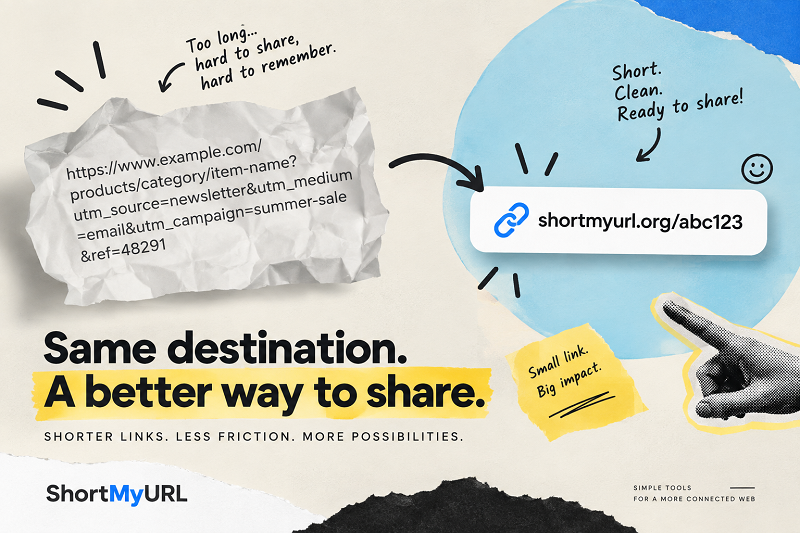
The problem isn't the URL itself. It's what happens when you share it.
Long URLs tend to become annoying at exactly the moment they leave the browser.
You might copy one into a messaging app and end up with a huge block of text. You might paste it into an email where it wraps across several lines. You might send it to a customer who wants to know where the link goes before clicking. Or perhaps you're creating a presentation, poster, social post, or campaign and simply don't want half the screen occupied by a URL.
There's also the human factor.
People are generally much better at recognizing short, meaningful pieces of information than remembering an address packed with parameters. A clean link can be easier to communicate verbally and easier to spot in a crowded message.
That doesn't mean every long URL needs to be shortened. Far from it. The useful question is whether the length creates a real problem in the context where you're using the link.
Not all long URLs are long for the same reason
Before doing anything with a URL, it helps to understand why it became long in the first place.
Some URLs are long because a website has a deep page structure:
example.com/blog/marketing/social-media/link-sharing-tips
Others become much longer because of query parameters:
example.com/search?category=marketing&sort=popular&page=3
Then there are tracking parameters added for analytics and campaigns:
example.com/offer?utm_source=facebook&utm_medium=social&utm_campaign=september
And sometimes a URL is simply the result of a complicated web application generating a page address automatically.
These situations aren't necessarily bad. In fact, those extra parameters can serve legitimate technical and marketing purposes. The mistake is assuming that because a URL looks messy, everything after the domain should simply be deleted.
Don't edit a URL blindly. Removing a parameter can sometimes change what page loads, remove tracking, alter a search result, or break the intended destination.
If the original URL needs all of its components, shortening the link at the sharing stage is often more sensible than manually modifying the destination.
Four moments when a long URL becomes a genuine nuisance
1. You're sending it to another person
This is probably the most obvious one.
A long URL buried inside a message makes the important part of the conversation harder to see. If you're sending a product page to a customer, a registration page to a colleague, or an article to a friend, the destination matters more than the technical machinery sitting behind the link.
A shorter link can make the message feel cleaner without changing the destination itself.
2. You're putting a link somewhere people have to read
Printed material is where long URLs really start showing their age.
Think business cards, posters, menus, event materials, brochures, classroom handouts, or a presentation slide. A URL that looks acceptable on a desktop browser can become ridiculous when printed at a useful font size.
This is especially relevant when someone may need to manually enter the address rather than simply click it.
A shorter address reduces the amount of typing and creates fewer opportunities for mistakes.
3. You're working with campaign links
Marketing links often have extra parameters for attribution. That's useful for the people analyzing the campaign, but it doesn't mean the entire tracking-heavy address needs to be the thing customers see.
For example, a campaign might require several parameters behind the scenes while the publicly shared link can remain much cleaner.
This is one of the most practical reasons to separate the destination URL from the URL people actually see and share.
4. You need something people can recognize quickly
A link doesn't always have to be memorable in the same way a domain name is memorable.
Sometimes you simply want someone to glance at a message and immediately understand that there's a link inside it. A compact URL has less visual noise, especially when several links appear in the same document or conversation.
The goal isn't to create a clever-looking link for its own sake. It's to remove unnecessary friction.
What a web URL shortener actually solves
This is where a URL shortening service becomes useful.
A web URL shortener creates a compact URL that redirects visitors to the original destination. Instead of asking someone to interact with a long technical address, you give them a shorter one.
The original URL can remain as complicated as it needs to be.
That's an important distinction. URL shortening isn't necessarily about “fixing” the original website address. It's about creating a more convenient version for distribution.
Think of it like packaging.
The product inside the box hasn't changed. You've simply chosen packaging that's easier to carry.
Short doesn't automatically mean better
Here's the part that often gets overlooked: shortening a URL isn't automatically an improvement.
If a link is already clean, readable, and easy to share, there's little reason to shorten it simply because you can.
There are also situations where transparency matters more than compactness. When users don't recognize a shortened domain, they may hesitate before clicking. A link should never be used to disguise where someone is being sent.
The same goes for temporary or unreliable services. If a shortened link stops working, gets deleted, or behaves unpredictably, saving a few characters wasn't worth much.
Before shortening an important URL, ask a few simple questions:
- Will the destination remain available?
- Does the short link redirect reliably?
- Can the link be customized or recognized?
- Is click tracking available if you actually need it?
- Is the shortening service trustworthy?
- Will the short link remain usable over time?
That last question matters more than people think.
A short URL printed on a poster has a very different job from a disposable link shared in a private chat.
There are times when you should leave the URL alone
Not every URL needs a makeover.
If you're sharing a simple homepage such as:
example.com
there's little point in turning it into something shorter.
Likewise, if you're communicating with a technical audience that needs to inspect the full destination, hiding the original structure may be counterproductive.
And if you're troubleshooting a website, developers may specifically need the complete URL and its parameters.
The better mindset is not “long URL = bad.”
It's “long URL + wrong context = unnecessary friction.”
That small distinction leads to much better decisions.
A quick test before you share a link
Before dropping a URL into a message, post, document, or campaign, look at it from the recipient's perspective.
Can they understand what they're clicking?
Can they copy it without accidentally cutting part of it off?
Would it look awkward if the message were viewed on a phone?
If someone had to type it manually, would they make mistakes?
And if the link contains tracking parameters or other technical information, does the recipient actually need to see all of that?
If the answer to several of these questions is “no,” you have a strong reason to consider a shorter shareable version.
It's a tiny bit of preparation that can make the final link feel dramatically cleaner.
The real purpose of a shorter link
The obsession with making URLs shorter can sometimes miss the point.
You're not competing to create the world's tiniest link. You're trying to make a digital address easier to use in the situation where it will actually be shared.
A long URL may be perfectly healthy from a technical perspective and still be inconvenient for a human being.
That's the gap URL shortening is designed to address.
So the next time you encounter an address that looks like it was assembled by a particularly enthusiastic robot, don't immediately start deleting characters. First figure out why the URL is long, whether those components are necessary, and how the link will be used.
If the destination needs to stay exactly as it is but the public-facing link doesn't need all that baggage, that's when a shorter URL starts making a lot of sense.