Which Website URLs Should You Actually Shorten?
Here's a slightly unpopular idea: you probably shouldn't shorten every URL on your website.
- Not Every Long URL Is a Bad URL
- Start With One Simple Question: Where Will This Link Be Used?
- Four Types of Links That Are Great Candidates
- Campaign Links
- Links That Appear in Print
- Links People Share Repeatedly
- Links People Need to Type or Remember
- And Then There Are Links You Should Probably Leave Alone
- Short URL vs. Original URL: A Practical Decision
- Don't Turn Your Website Into a Maze of Redirects
- What About SEO?
- The Mistake of Shortening Everything
- A Better Rule: Shorten Strategically
- What to Look for in a Website Shortener
- The Best URL Strategy Is a Mixed One
Yes, short links are cleaner. They're easier to share, easier to remember, and much less annoying when they have to appear on a poster or inside a text message. But that doesn't mean every URL on your website needs to pass through a URL shortener.
Your website might have hundreds or thousands of URLs, and many of them are doing exactly what they're supposed to do. An internal article link doesn't suddenly become better because you've replaced it with a mysterious six-character code.
The trick is knowing the difference between a URL that exists for website navigation and a URL that exists to be shared with another human.
That's where things get interesting.
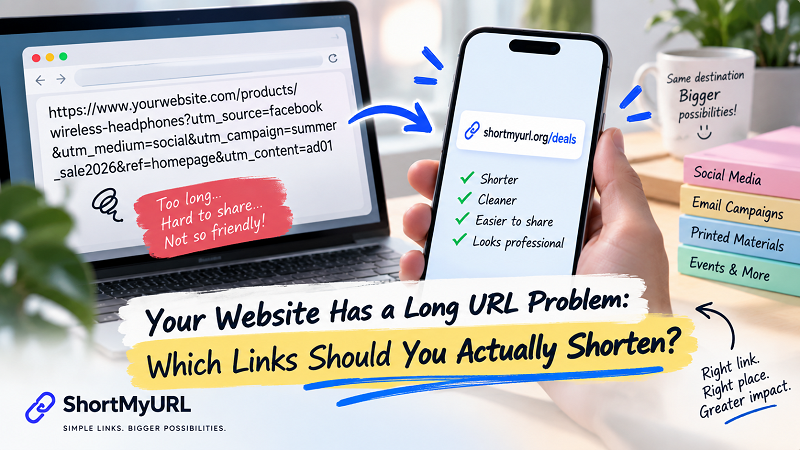
Not Every Long URL Is a Bad URL
A long URL can look intimidating, but length by itself isn't a good reason to shorten it.
Consider a normal product page:
example.com/products/wireless-headphones
It's reasonably descriptive. Someone can look at it and understand what they're about to visit.
Now imagine a campaign URL:
example.com/products/wireless-headphones?utm_source=newsletter&utm_medium=email&utm_campaign=holiday_sale
That's a different story.
The second URL may contain valuable tracking information, but it's not particularly pleasant to paste into a social post, print on a flyer, or read aloud to someone.
This is the distinction worth remembering:
A URL can be technically useful without being practically shareable.
Shortening makes the most sense when you're solving the second problem.
Start With One Simple Question: Where Will This Link Be Used?
Instead of looking at the URL itself, look at its next destination in the real world.
If the link is staying inside your website, shortening it is often unnecessary. Your navigation menu, related articles, product recommendations, and internal links can usually point directly to the destination.
If the link is leaving your website and being handed to another person, the calculation changes.
A link included in an email may benefit from being compact. A URL printed on a restaurant menu has very different requirements from one sitting behind a button on a homepage. A campaign link shared across several social platforms may need a different approach again.
The useful question isn't:
“Is this URL long?”
It's:
“Will shortening this URL make the way people use it easier?”
That question eliminates a surprising amount of unnecessary URL housekeeping.
Four Types of Links That Are Great Candidates
Some URLs are practically asking to be shortened.
Campaign Links
Marketing campaigns are probably one of the clearest examples.
Tracking parameters can turn an ordinary destination into an extremely long address. Those parameters may be important to analytics, but customers don't necessarily need to see them.
A short public-facing link can provide a cleaner entry point while the destination retains the information needed for measurement.
This is particularly useful when the same campaign is promoted through multiple channels and you want each shared link to be easy to recognize.
Links That Appear in Print
Print changes everything.
On a screen, someone can simply tap a link. On a poster, business card, brochure, product package, or event sign, the person may have to type it manually.
That's when a long URL becomes more than an aesthetic problem.
Imagine asking someone to type:
example.com/events/2026/autumn-community-market/register-now
It's possible, but there's a good chance something gets mistyped.
A shorter address dramatically reduces that friction.
And if the printed material also includes a QR code, the short URL can serve as a useful human-readable backup for people who prefer typing or want to know where the code leads.
Links People Share Repeatedly
Some URLs naturally travel.
Maybe it's a registration page. Maybe it's a frequently recommended article. Maybe it's a special promotion or a public resource your team sends to customers every week.
If the same long URL is being copied and pasted over and over, shortening it can make the process more convenient for everyone involved.
The more often a link is shared, the more valuable simplicity becomes.
Links People Need to Type or Remember
This is where a short link can become more than just a cleaner-looking URL.
Suppose you're telling someone a web address over the phone. Or you're putting an address on a presentation slide while an audience is expected to type it. Or you're giving customers a URL during an event.
A memorable short alias can be dramatically easier to communicate than a long path filled with numbers, folders, and parameters.
That's not an SEO trick. It's simply better communication.
And Then There Are Links You Should Probably Leave Alone
This is the part many URL-shortening articles skip.
Sometimes the original URL is already doing a good job.
An internal link such as:
example.com/blog/how-to-choose-a-domain-name
is readable, descriptive, and perfectly suitable for website navigation.
Replacing it with:
short.example/x7K29
doesn't necessarily improve anything. In fact, you've now introduced an additional redirect and made the destination less obvious.
The same applies to links where transparency is useful. If someone is deciding whether to click a link, seeing the actual website domain and a meaningful path can provide useful context.
Shorter isn't automatically better.
Sometimes clearer beats shorter.
Short URL vs. Original URL: A Practical Decision
Here's a simple way to think about it.
| Where the link is used | Shorten? | Why |
|---|---|---|
| Internal website navigation | Usually no | Direct links are simple and transparent |
| Blog-to-blog internal links | Usually no | The original URL is often descriptive |
| Printed flyer | Often yes | Easier to type and remember |
| Business card | Often yes | Space is limited |
| Social media sharing | Often useful | Cleaner presentation |
| Campaign URL with tracking parameters | Often useful | Keeps the public link manageable |
| Event registration | Often useful | Easier to communicate |
| Frequently shared resource | Often useful | Less friction when sharing repeatedly |
| Private dashboard link | Depends | Access restrictions still apply |
| Already short, readable URL | Probably no | Little benefit to changing it |
The goal isn't to create a shortened version of every address your website owns.
It's to identify the URLs where shortening creates an actual improvement.
Don't Turn Your Website Into a Maze of Redirects
There is another reason to be selective.
Every shortened URL introduces another layer between the person clicking and the final destination. That's not necessarily a problem, but unnecessary layers don't provide much value.
Imagine this:
Visitor → Short Link A → Short Link B → Redirect → Website
That's a lot of moving parts for a simple click.
If a direct URL already works perfectly for its intended purpose, adding another redirect doesn't magically make the experience better.
This is why strategic shortening is preferable to blanket shortening.
Use a short link where it solves a problem. Leave a perfectly good URL alone when it doesn't.
What About SEO?
This is where things can get confusing.
A short link and an SEO-friendly website URL serve different purposes.
Your site's own URLs should generally be designed around the structure and usability of your website. A descriptive page URL can help users understand where they are and what a page contains.
A short shareable URL is solving a different problem.
For example, your website might have a detailed destination URL for a particular article while you use a compact link when promoting that article in a printed campaign.
Those two URLs don't need to compete with each other. They have different jobs.
Think of it as the difference between a permanent address and a convenient way to tell someone how to get there.
Once you separate those roles, the whole subject becomes much less confusing.
The Mistake of Shortening Everything
There is a certain appeal to having a neat collection of short URLs. Everything looks tidy. Every link has a compact code. Problem solved.
Except you've potentially created a new problem: now you have to manage all those shortened links.
Which short link points to which page? Is that destination still active? Was the original page moved? Which campaign uses this alias? Is this link still being shared somewhere?
For a small number of important links, that's manageable.
For hundreds of unnecessary shortened URLs, it can become administrative clutter.
There's also the transparency issue. A user looking at:
example.com/pricing
has a pretty good idea where the link goes.
A random short URL tells them much less.
That doesn't make short links bad. It simply means they should be used where their advantages outweigh the information they hide.
A Better Rule: Shorten Strategically
If you're unsure whether a particular URL deserves to be shortened, run through four questions.
Will people share it?
If yes, a shorter version may make sense.
Will people have to type it?
If yes, reducing the number of characters can make a real difference.
Will it appear in printed material?
If yes, a compact URL is usually more practical.
Is it simply being used as an internal website link?
If yes, there may be little reason to shorten it.
This approach is much more useful than simply declaring that “shorter URLs are better.”
Sometimes they are.
Sometimes they're not.
What to Look for in a Website Shortener
When you do have a link worth shortening, the tool itself should stay out of your way.
A useful website shortener should make the basic process simple while giving you enough control over the links that matter.
Depending on your needs, useful features may include custom aliases, click tracking, link management, and reliable redirects. If you're creating links for long-running campaigns or printed materials, the expected lifespan of those links matters too.
You don't need to turn every short URL into a sophisticated analytics project. For many people, the most valuable feature is simply having a compact, dependable link that can be shared without making everyone stare at a wall of characters.
Choose the features based on the job, not because a dashboard happens to have twenty buttons.
The Best URL Strategy Is a Mixed One
A website doesn't need to choose between “long URLs” and “short URLs.”
It can — and probably should — use both.
Keep descriptive URLs where they make sense for the website itself. Use short links when a URL needs to travel beyond the website and become something people share, type, print, remember, or communicate.
That gives each type of URL a clear purpose.
The original website URL remains the destination. The short link becomes the convenient route people use to get there.
And that leads to a much more useful principle than “shorter is better”:
Don't shorten URLs because you can. Shorten them because it makes someone's next interaction easier.