Why Happy Customers Forget to Leave Reviews (And How to Fix It)
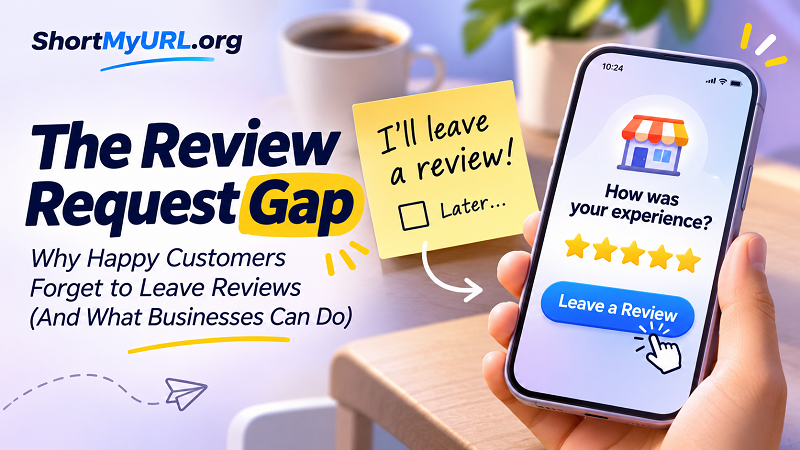
A customer walks out of your store with a smile. They loved the service, appreciated the experience, and even said, "I'll leave you a review!" Sounds like a win, right?
- The Moment After a Great Experience Is Your Biggest Opportunity
- Follow the Customer's Journey, Not Your Review Collection Routine
- Right After the Service: When the Experience Is Still Fresh
- The Thank-You Message: A Second Chance to Make It Easy
- The Follow-Up: How to Remind Without Becoming Annoying
- The Review Link Should Do One Job: Get Customers to the Right Place
- What a Good Review Request Actually Sounds Like
- SMS After a Completed Service
- Email After a Purchase
- A Gentle Follow-Up
- QR Codes at the Checkout Counter
- Don't Turn Review Collection Into a Trust Problem
- Build a Review Process That Doesn't Depend on Memory
- Make Leaving a Review the Easiest Part of a Great Experience
Then three days pass. Nothing. A week later, still nothing. That glowing customer experience has somehow disappeared without a single review to show for it.
Before blaming customers for being forgetful, consider something more interesting: the gap between wanting to leave a review and actually doing it is often where businesses lose the opportunity.
People aren't necessarily refusing to support your business. They're busy, distracted, switching between apps, and dealing with a dozen other things. Your review request might be competing with dinner, work notifications, school pickups, and whatever else life throws at them.
The good news? You don't need to chase every customer or beg for five stars. You need to make the process feel natural, convenient, and worth completing.
The Moment After a Great Experience Is Your Biggest Opportunity
Think about the last time you had a genuinely good experience at a restaurant, salon, repair shop, or local business. You probably felt positive about it. You might even have wanted to tell someone.
But wanting to do something doesn't automatically mean you'll do it.
Customers experience the same thing. They may genuinely appreciate your service, but once they leave, their attention moves elsewhere. The positive experience becomes another memory in an increasingly crowded day.
This is why the moment immediately after a successful interaction matters. The customer still remembers the details, the people who helped them, and what made the experience worthwhile.
However, timing is about context, not simply speed. Asking for a review while someone is rushing out the door may feel awkward. Asking after a successful appointment, once the customer has had a moment to appreciate the result, can feel much more appropriate.
The goal isn't to interrupt a happy customer with another task. It's to offer an easy way to share their experience while it's still fresh.
Follow the Customer's Journey, Not Your Review Collection Routine
Many businesses approach reviews from an operational perspective: send a message, wait for a response, and repeat.
Customers don't think that way. They experience your business as a series of interactions, and the review request should fit into that journey rather than feel like an unrelated marketing campaign.
Right After the Service: When the Experience Is Still Fresh
A completed transaction creates a natural opportunity to say thank you. A short, genuine conversation can be more effective than immediately launching into a sales-like request.
For example, a mechanic might say, "Glad we could get your car sorted out today. If you have a moment later, we'd really appreciate hearing about your experience."
Notice what's missing: pressure, exaggerated enthusiasm, and demands for a positive rating.
You're simply opening the door.
The Thank-You Message: A Second Chance to Make It Easy
Not every customer has time to respond in person. That's where a follow-up message can help.
A short SMS or email thanking customers for choosing your business gives them another opportunity to share feedback. Include the review destination directly instead of making them search for your business.
Keep the message personal and relevant. A customer who just received a haircut doesn't need a corporate-sounding paragraph about your commitment to excellence.
They need a friendly thank-you and a clear next step.
The Follow-Up: How to Remind Without Becoming Annoying
Sometimes customers see your message, intend to respond, and forget again. A gentle reminder may help, but there's a fine line between being helpful and becoming irritating.
One considerate follow-up is generally more appropriate than sending repeated notifications. If the customer doesn't respond, respect that decision.
Your business is trying to build trust, not win a notification battle.
The Review Link Should Do One Job: Get Customers to the Right Place
Here's a surprisingly common mistake: asking customers to leave a review but making them figure out where to do it.
Imagine receiving this message:
"Thanks for visiting! Please search for our business on Google and leave us a review."
That's an unnecessary scavenger hunt. Customers have to open Google, enter a business name, identify the correct location, navigate the profile, and find the review option.
Every extra action creates another opportunity for distraction.
Instead, use a direct review link that takes customers to the appropriate destination. Google Business Profile allows eligible businesses to create a review link and QR code, making it easier to share review requests through messages, receipts, and other customer touchpoints.
If your business has multiple locations, check that each link points to the correct branch. Sending a customer to the wrong location is a small mistake that can create a surprisingly frustrating experience.
You can also use a short link generator to turn a lengthy review URL into a cleaner, more manageable link for SMS messages, email campaigns, printed receipts, and social media communications.
A shorter link isn't automatically a better review experience, though. Always test the destination before sharing it. The customer should land in the right place, not on your homepage or an unrelated page.
Think of the link as a bridge between customer satisfaction and customer action. If that bridge is confusing, even a happy customer may never cross it.
What a Good Review Request Actually Sounds Like
A review request doesn't need to sound like advertising. In fact, the more it resembles a genuine conversation, the more naturally it fits into the customer experience.
Here are a few practical examples businesses can adapt.
SMS After a Completed Service
"Hi [Customer Name], thanks for choosing [Business Name]! We hope everything went smoothly. If you'd like to share your experience, you can leave us a review here: [Review Link]. We appreciate your feedback!"
Short, friendly, and easy to understand. No dramatic language, no unnecessary explanation.
Email After a Purchase
Subject: Thanks for choosing us!
"Hi [Customer Name],
Thank you for shopping with [Business Name]. We appreciate your support and hope you're happy with your purchase.
If you have a moment, we'd love to hear about your experience. Your honest feedback helps us understand what we're doing well and where we can improve.
Share your feedback here: [Review Link]
Thanks again for being our customer!"
This works particularly well when the email is part of an existing post-purchase communication flow.
A Gentle Follow-Up
"Hi [Customer Name], just checking in to see how everything is going with your recent visit to [Business Name]. If you haven't had a chance to share your feedback and would like to, here's the link: [Review Link]. Thanks again!"
The important phrase is "if you'd like to." Customers should feel free to participate or ignore the request without being pressured.
QR Codes at the Checkout Counter
Not every review request needs a message. A QR code displayed at a checkout counter, reception desk, or service area can give customers a convenient option while they're already interacting with your business.
Keep the presentation simple. A short message such as "How was your experience? We'd love your feedback" is usually enough.
Make sure the QR code works, is easy to scan, and leads to the correct review destination. A beautifully designed sign with a broken QR code is just expensive decoration.
Don't Turn Review Collection Into a Trust Problem
There's a temptation to accelerate review collection with discounts, gifts, contests, or rewards. It might sound like an easy shortcut, but it can damage the credibility you're trying to build.
Google prohibits offering incentives in exchange for reviews. Businesses should not pay customers, offer discounts, or provide free products in return for positive feedback.
There's another important distinction: asking customers for honest feedback is not the same as asking only satisfied customers to leave public reviews while directing unhappy customers elsewhere.
Your review process should give customers a fair opportunity to express their genuine experiences.
A few principles are worth keeping in mind:
- Never purchase reviews or manufacture customer feedback.
- Don't offer rewards in exchange for positive ratings.
- Avoid pressuring customers to change or remove negative reviews.
- Don't repeatedly message people who have already ignored your request.
- Respond professionally to criticism instead of becoming defensive.
Negative feedback isn't necessarily a disaster. Sometimes it reveals a service problem that your business hasn't noticed. A thoughtful response can demonstrate accountability to future customers.
Remember, the objective is to earn trust, not manufacture a perfect-looking rating.
Build a Review Process That Doesn't Depend on Memory
If your entire review strategy depends on an employee remembering to ask every customer, results will probably be inconsistent.
Some customers will receive a request immediately. Others will leave without hearing anything. Busy days will create gaps, and different employees may use completely different approaches.
A simple process makes the experience more consistent.
Start by preparing the correct review links for each business location. Store approved message templates where your team can access them. Decide which customer touchpoints are most appropriate for asking for feedback, such as after a completed appointment or a successful purchase.
Then establish a reasonable follow-up policy. For example, a business might send one initial request after service completion and one gentle reminder several days later, provided the customer hasn't opted out and the communication complies with applicable messaging rules.
Finally, measure the process without confusing activity with results.
Link clicks can tell you whether customers are opening your messages. They don't prove that someone completed a review. Track actual reviews separately and look for patterns in timing, communication channels, and customer feedback.
This helps your business improve the process based on real outcomes rather than assumptions.
Make Leaving a Review the Easiest Part of a Great Experience
A customer who promises to leave a review isn't necessarily making an empty promise. They may genuinely intend to do it. But good intentions are easily buried under everyday distractions.
That's why successful review collection isn't about asking louder or sending more reminders. It's about understanding the customer's journey and removing unnecessary friction.
Give people a natural opportunity to respond, provide a direct destination, use friendly language, and respect their choice. Most importantly, keep delivering experiences worth talking about.
You can't control whether every customer writes a review. But you can control how easy, comfortable, and straightforward it is for them to share their experience.
Sometimes, the difference between a forgotten promise and a completed review is simply one well-timed message and one link that actually takes customers where they need to go.