When a Free URL Shortener Is Enough for Your Workflow
Not every link needs a marketing platform behind it.
- Start With What You Actually Need
- Free Doesn't Automatically Mean Limited
- The Casual Sharer
- When You Need a Link to Be Memorable
- What About Campaigns?
- Analytics Are Useful—But Ask What You Need to Know
- Free Tools Can Be Particularly Useful for Small Projects
- There Are Some Things You Should Still Check
- When Free Stops Being Enough
- Don't Pay for Features You Won't Use
- The Best Tool Is the One That Fits the Job
That might sound obvious, but the internet has a funny habit of turning simple tasks into complicated workflows. You want to shorten a URL, so suddenly you're looking at dashboards, conversion funnels, audience segmentation, advanced attribution, team permissions, integrations, and a dozen other features you may never touch.
Those tools can be useful. But they can also be completely unnecessary if all you need is a cleaner link to share.
The better question isn't whether a sophisticated link management platform can do more. Of course it can. The question is whether you actually need those extra capabilities for the way you work.
For many people, the answer is surprisingly simple.
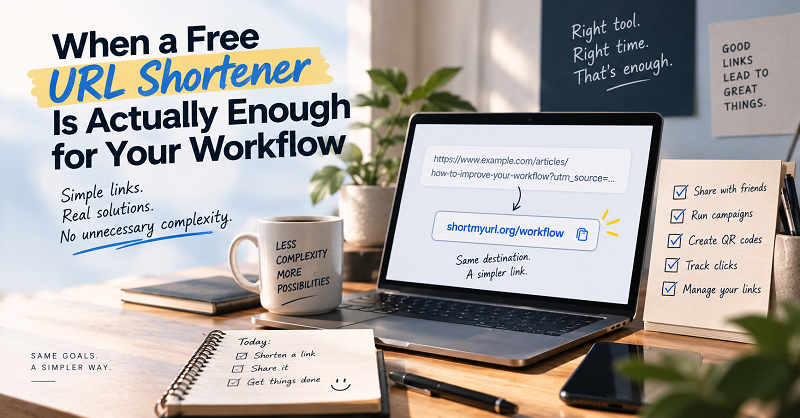
Start With What You Actually Need
Before choosing a link tool, forget about the feature list for a moment. Think about what you're trying to accomplish.
Maybe you have a long URL from an article and want something easier to send in a message. Maybe you're putting a link on a flyer. Perhaps you need a memorable address for a campaign, or you simply want to keep track of a few links instead of digging through browser history every time you need one.
Those are relatively straightforward problems.
You don't necessarily need a sophisticated marketing stack to solve them. In fact, adding too much functionality can sometimes make a simple workflow more cumbersome. Creating an account, configuring multiple settings, navigating a complicated dashboard, and learning terminology you don't actually need can take more time than the original task.
A useful tool should match the problem, not make the problem bigger.
Free Doesn't Automatically Mean Limited
There's a persistent assumption that if a tool is free, it's probably just a stripped-down version of something better.
Sometimes that's true. Sometimes it's not.
A free service can be perfectly capable when its core features match what you're trying to accomplish. If you need to turn a long URL into a shorter one and share it, you don't necessarily need ten additional features before the link becomes useful.
This is particularly true for occasional users. Someone who shortens a couple of links every week has a fundamentally different set of requirements from a marketing team managing thousands of campaign URLs across multiple clients.
Treating those two users as if they need the same software is how simple tools become unnecessarily complicated.
The Casual Sharer
Let's start with the simplest case.
You find an interesting article, product page, event registration form, or online resource. The URL is ridiculously long, and you want to send it to somebody without dropping an entire paragraph of characters into the conversation.
That's it.
You don't need an elaborate analytics setup. You don't need campaign attribution. You don't need a team dashboard. You just need a shorter link that works.
For this kind of situation, a url shortener free service can be more than enough. The value isn't in having hundreds of features. It's in removing a small piece of friction from something you already do every day.
And honestly, there's something refreshing about software that solves the problem and gets out of your way.
When You Need a Link to Be Memorable
There are situations where simply shortening a URL isn't quite enough.
Imagine you're telling someone about a landing page over the phone. Or you're putting a link on a presentation slide. Or you're sharing a campaign URL that people may see several times.
A random shortened address can be shorter without being particularly memorable. If the service allows custom aliases, you may be able to create something that gives the recipient a better idea of what they're looking at.
That's useful for more than aesthetics.
A meaningful link can make it easier to recognize a campaign, distinguish one destination from another, or remember an address after seeing it once. The key is not to make the alias clever for the sake of being clever. It should be short, relevant, and understandable.
If a custom alias solves that problem, you don't necessarily need a much larger platform just to get it.
What About Campaigns?
This is where things get more interesting.
A small business might run a promotion for a new product. A creator might promote a newsletter. An event organizer might distribute a registration link. A nonprofit might share a donation page.
All of these activities involve campaigns, but not every campaign requires an enterprise-level marketing system.
If you only need a manageable link that can be shared across social media, email, printed materials, or a QR code, a basic shortening service may cover the essentials.
The moment you need detailed attribution across multiple channels, audience-level reporting, automated workflows, integrations with other marketing systems, or complex team management, the requirements start changing. That's when a more advanced solution may become relevant.
The important distinction is that “I am running a campaign” doesn't automatically mean “I need advanced marketing software.”
Campaign complexity matters more than the word campaign itself.
Analytics Are Useful—But Ask What You Need to Know
Click analytics are one of the most tempting features in the URL-shortening world.
Knowing how many people clicked a link can be useful. It can help you understand whether something is getting attention and give you a basic sense of engagement.
But there's a big difference between asking, “How many times was this link clicked?” and asking, “Which audience segment converted after seeing this campaign through which channel?”
The first question may only require basic click tracking.
The second can involve a much broader measurement system.
This is a useful way to evaluate software in general: don't ask whether a feature exists. Ask what decision you're trying to make with the information it provides.
If all you want to know is whether people are clicking a shared link, basic analytics may be enough. If you're building a sophisticated attribution model across multiple campaigns, you'll probably need more specialized tools.
Free Tools Can Be Particularly Useful for Small Projects
There's another situation where free link tools make a lot of sense: projects that simply aren't large enough to justify additional complexity.
Maybe you're organizing a community event. Maybe you're building a personal website. Maybe you're testing an idea before investing in a larger campaign. Maybe you're creating a temporary promotional page for a small business.
At this stage, every additional tool introduces another thing to configure, maintain, and potentially pay for.
A lightweight solution lets you move quickly.
That's not about choosing free software because spending money is bad. It's about matching the cost and complexity of the tool to the size of the problem.
If you're sending 20 links a month, you probably don't need the same infrastructure as a company distributing millions of campaign links.
There Are Some Things You Should Still Check
“Free” shouldn't mean “use the first thing you find.”
Before relying on any URL shortening service, take a moment to understand how it works. Does the link remain active? Does the service clearly explain its policies? Can you manage links if you create an account? Does it offer the features you actually need? Are there restrictions that could become a problem later?
Privacy is worth considering too, particularly if the service provides analytics. If clicks are being tracked, understand what information is collected and how it is handled. Businesses should also consider whether the service's practices fit their own privacy obligations and policies.
Reliability matters as well. A shortened link creates a dependency on the shortening service. If the service stops operating, changes its policies, or removes your links, the consequences can extend to every place where those links have been published.
In other words, the fact that something is free shouldn't stop you from doing basic due diligence.
When Free Stops Being Enough
There eventually comes a point where a basic tool may no longer fit the workflow.
You might have a large team that needs shared access. You may need sophisticated reporting across hundreds or thousands of links. Perhaps you require integrations with other marketing platforms, advanced campaign attribution, detailed permissions, or more extensive link management.
At that point, paying for additional functionality can make sense because the software is solving a larger operational problem.
But notice what happened: the need came first.
You didn't upgrade because someone told you that serious marketers need a premium platform. You upgraded because your workflow became complicated enough to benefit from one.
That's a much healthier way to choose software.
Don't Pay for Features You Won't Use
Software pricing pages are designed to make you notice what you could have.
That's not necessarily a bad thing. Features can be genuinely valuable. But a long feature list can also make a basic requirement look more complicated than it really is.
Before choosing a paid plan, make a small list of what you actually need.
Do you need shorter links? Custom aliases? Basic click counts? Link storage? QR codes? Team access? Advanced analytics? Integrations?
Then separate the essentials from the nice-to-haves.
If the free option handles everything in the first group, there may be no practical reason to upgrade yet.
And that's okay.
You can always move to a more advanced workflow later when your requirements change.
The Best Tool Is the One That Fits the Job
There's no universal definition of “enough.”
A creator sharing a handful of links, a small business running a local promotion, and a global marketing team may all use URL shortening for completely different reasons. One might need nothing more than a clean link. Another might need detailed reporting and integrations.
The mistake is assuming that everyone should start with the most powerful option.
For many everyday use cases, a free URL shortening service can handle the core job remarkably well: take a complicated address, make it easier to share, and help you manage the resulting links when needed.
If that's all your workflow requires, there's nothing missing.
And if your needs eventually grow, you can add complexity when it actually becomes useful—not simply because a pricing page convinced you that you needed it.
Sometimes the smartest workflow is the one with fewer moving parts.