What Is a URL Shortener? How Short Links Work From Click to Redirect
You've probably seen a short link before.
- What Is a URL Shortener?
- What Is a Short URL?
- Why Do Long URLs Exist?
- Different Parts Can Have Different Jobs
- How Does a URL Shortener Work?
- What Happens When You Click a Short Link?
- 1. You Open the Short URL
- 2. The Service Receives the Request
- 3. The Destination Is Found
- 4. The Browser Is Redirected
- 5. You Arrive at the Destination
- What Is a URL Redirect?
- Why Are Redirects Useful?
- Why Use a URL Shortener?
- Shorter Links Are Easier to Share
- Shorter Links Are Easier to Type
- Short Links Can Look Cleaner
- Short Links Can Be More Memorable
- What Is a Custom Short URL?
- Why Do Custom Aliases Matter?
- Can a URL Shortener Track Clicks?
- Can One Destination Have Multiple Short Links?
- Can a Short URL Be Used in a QR Code?
- Are URL Shorteners Only for Businesses?
- Are Short URLs Better Than Long URLs?
- Are Shortened URLs Safe?
- Do URL Shorteners Affect SEO?
- Do Short URLs Expire?
- What Makes a Good URL Shortener?
- A Simple Creation Process
- Custom Link Options
- Link Analytics
- QR Code Support
- Link Management
- Clear Policies
- Create a Short Link With ShortMyURL
- Frequently Asked Questions
- What is a URL shortener?
- What is a short URL?
- How does a URL shortener work?
- What happens when someone clicks a short URL?
- Can I customize a short URL?
- Can a URL shortener track clicks?
- Can multiple short URLs point to the same page?
- Can short URLs be used with QR codes?
- Are shortened URLs safe?
- Do short URLs expire?
- Final Takeaway
Maybe it looked something like: shortmyurl.org/x7K2p
At first glance, it doesn't tell you much. It's short, neat, and easy to share—but how does that tiny URL know where to send you?
That's where a URL shortener comes in.
A URL shortener creates a compact web address that points to a longer destination URL. When someone opens the short link, the service processes the request and redirects the visitor to the original page.
Simple idea. Surprisingly useful technology.
Let's take a closer look at what's happening behind that little link.
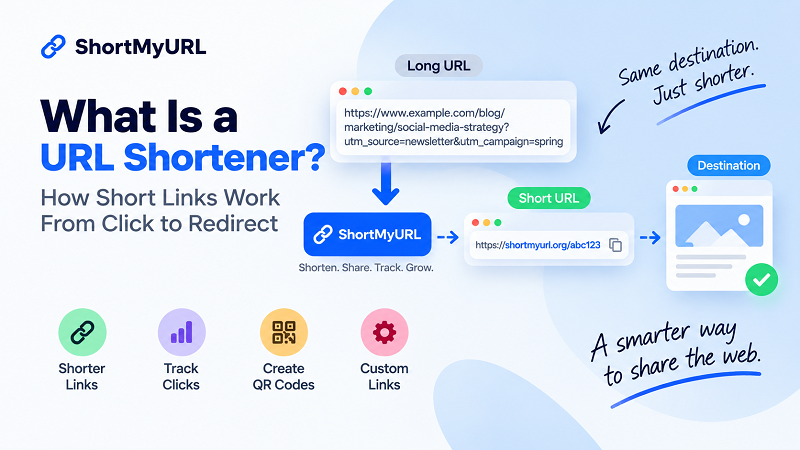
What Is a URL Shortener?
A URL shortener is a tool or service that converts a long web address into a shorter URL.
For example, a website might have a page with an address like:
https://www.example.com/resources/digital-marketing/social-media/how-to-create-a-content-plan?utm_source=facebook&utm_medium=social&utm_campaign=summer
That's a perfectly valid URL.
It's just not particularly convenient to share.
A URL shortener can create a much more compact address, such as:
shortmyurl.org/content
The short URL is connected to the original destination.
When someone visits the shortened address, they're redirected to the longer URL.
So the basic concept is:
Long URL → Short URL → Redirect → Destination
The short link doesn't replace the original webpage. It provides another path to reach it.
What Is a Short URL?
A short URL is a compact web address that points to a destination elsewhere on the web.
Most short URLs contain two main elements:
The domain
This identifies the URL shortening service.
The identifier or alias
This identifies the particular short link.
For example:
shortmyurl.org/coffee
Here, shortmyurl.org is the domain and coffee is the short-link identifier.
The identifier may be randomly generated, or it may be customized when the service supports custom aliases.
Why Do Long URLs Exist?
Before asking why people shorten URLs, it's worth asking why URLs can become so long.
A URL can contain much more than a domain name.
Consider:
https://example.com/products/shoes
That's relatively short.
Now add categories, product information, filters, searches, and campaign parameters:
https://example.com/products/shoes/mens/running?size=10&color=black&utm_source=instagram&utm_campaign=fall
Suddenly, the address gets much bigger.
Different Parts Can Have Different Jobs
A long URL may contain:
- Domain information
- Folders or paths
- Page identifiers
- Search terms
- Filters
- Product information
- Tracking parameters
- Other query parameters
These elements can be useful to the website.
The problem isn't necessarily that the URL is technically too long.
The problem is that long URLs aren't always pleasant for humans to handle.
That's one of the main reasons short links exist.
How Does a URL Shortener Work?
The underlying concept is basically a lookup system.
When you create a short link, the shortening service creates a unique identifier and associates it with your destination URL.
Imagine this relationship:
| Short link | Destination |
|---|---|
| shortmyurl.org/abc123 | example.com/a/very/long/page |
The service stores that connection.
Later, when someone visits:
shortmyurl.org/abc123
the system recognizes abc123, finds the destination associated with it, and redirects the visitor.
That's the magic.
Or, more accurately, that's a database lookup followed by a redirect—but "magic" sounds better.
What Happens When You Click a Short Link?
Let's follow a click from beginning to end.
1. You Open the Short URL
You click or enter something like:
shortmyurl.org/abc123
Your browser sends a request to the short-link domain.
2. The Service Receives the Request
The URL shortening system receives the request and reads the identifier at the end of the URL.
In this example:
abc123
3. The Destination Is Found
The system checks which original URL is associated with that identifier.
For example:
abc123 → https://www.example.com/products/coffee
4. The Browser Is Redirected
The service responds with a redirect telling the browser where to go next.
5. You Arrive at the Destination
Your browser loads the original webpage.
From your perspective, the whole thing can feel like one simple action:
Click → Page opens
But behind the scenes, the short link has acted as the middleman between you and the destination.
What Is a URL Redirect?
A redirect is a mechanism that sends a browser from one URL to another.
URL shorteners rely on redirects because the short address isn't normally the final content destination.
For example:
shortmyurl.org/deals
can point to:
example.com/store/summer-deals
The visitor starts at the first address and ends up at the second.
Why Are Redirects Useful?
Redirects aren't unique to URL shorteners.
Websites use them for many reasons, including:
- Moving pages
- Changing domains
- Consolidating URLs
- Handling old links
- Campaign tracking
- Creating convenient shortcuts
A URL shortener simply uses this basic web mechanism to create a compact path to another URL.
Why Use a URL Shortener?
The technology is interesting, but most people don't use a URL shortener because they love HTTP redirects.
They use one because short links are convenient.
Shorter Links Are Easier to Share
A compact URL is easier to copy and paste into messages, emails, social posts, and other places.
Shorter Links Are Easier to Type
If someone has to manually enter a URL, every unnecessary character creates another opportunity for a typo.
A shorter address solves part of that problem.
Short Links Can Look Cleaner
A huge URL can dominate a message.
A compact link takes up less visual space and keeps attention on the surrounding content.
Short Links Can Be More Memorable
A custom ending can make a short link easier to recognize.
For example:
shortmyurl.org/menu
is easier to remember than:
shortmyurl.org/9xP72k
when both point to the same destination.
What Is a Custom Short URL?
Some URL shortening services allow you to choose the identifier used in a short link.
Instead of receiving something random like:
shortmyurl.org/f83K2
you might create:
shortmyurl.org/pricing
if the alias is available.
This is known as a custom short URL or custom alias.
Why Do Custom Aliases Matter?
A recognizable alias can provide context before someone clicks.
Compare:
shortmyurl.org/a8Q91
with:
shortmyurl.org/event
The second link immediately gives you an idea of what it might be about.
Custom aliases can be particularly useful for:
- Events
- Promotions
- Campaigns
- Products
- Landing pages
- Social media
- Printed materials
The trick is not to overthink it.
Short, relevant, and easy to spell usually wins.
Can a URL Shortener Track Clicks?
Some URL shortening services can collect analytics when people use their short links.
Instead of simply knowing that a link exists, you may be able to see how it is being used.
Depending on the service, analytics can include:
- Total clicks
- Click activity over time
- Referral information
- Device information
- Browser information
- Approximate geographic data
This can be useful for marketing campaigns.
For example, you could create different short links for different promotional channels while sending all of them to the same destination.
If analytics are available, the activity associated with each link can help you understand which channels are generating clicks.
Of course, analytics aren't identical across providers. The information collected, retention practices, and privacy controls can vary.
Can One Destination Have Multiple Short Links?
Yes.
You can potentially create multiple short URLs that point to the same destination.
For example:
shortmyurl.org/email
and:
shortmyurl.org/social
could both lead to:
example.com/summer-sale
Why would you do that?
Because each short link can represent a different sharing context.
If analytics are supported, separate links can make it easier to distinguish activity between channels.
This is particularly useful when you're testing different campaigns or distribution methods.
Can a Short URL Be Used in a QR Code?
Absolutely.
A QR code can encode a URL, and a short URL can be used as that destination.
This creates a simple bridge between physical and digital content.
For example:
Poster → QR code → Short URL → Website
Someone sees your poster, scans the code, and is sent to the intended webpage.
Short links can be particularly convenient for QR campaigns because they provide a compact destination and can sometimes be managed or tracked through the same link platform.
Are URL Shorteners Only for Businesses?
Not at all.
You don't need to run a company or marketing campaign to use short links.
Everyday users can find them useful for sharing:
- Articles
- Videos
- Recipes
- Online resources
- Event pages
- Product pages
- Forms
- Maps
- Community resources
Businesses may use them heavily because of analytics and campaign management, but the basic benefit—making a long URL easier to share—is useful to almost anyone.
Are Short URLs Better Than Long URLs?
There's no universal rule that short URLs are always better.
A long URL can be perfectly useful.
In fact, a descriptive URL on your own website can sometimes help users understand what page they're visiting.
Short links solve a different problem.
They are especially useful when the sharing experience matters more than showing the full destination structure.
Think of it as the difference between a full street address and a shortcut you've saved on your phone.
Both can get you there.
One is simply easier to use in certain situations.
Are Shortened URLs Safe?
A shortened URL isn't inherently safe or unsafe.
The main consideration is the destination behind the link.
Because a short URL doesn't reveal the complete destination at a glance, users may have less information about where they'll end up.
That's why it's smart to treat unexpected short links with caution.
Be especially careful with links received from:
- Unknown senders
- Suspicious accounts
- Unexpected messages
- Unfamiliar websites
For link creators, the obvious rule is even simpler:
Know where your link leads before you share it.
Do URL Shorteners Affect SEO?
URL shortening and SEO are related, but they aren't the same thing.
A short link is primarily a sharing and redirection mechanism. It isn't an SEO strategy by itself.
Search engines can process redirects, but the technical implementation matters. Website owners should make sure redirects are configured appropriately for their intended purpose.
For your own website's SEO, factors such as useful content, crawlability, site structure, page relevance, and the actual destination URL remain important.
In other words, don't expect a shorter link to magically push a page higher in search results.
Its biggest advantage is usability.
Do Short URLs Expire?
This depends entirely on the service creating them.
Some providers may keep links active indefinitely, while others may have policies involving accounts, inactivity, abuse, or other conditions.
If you're creating a link that will appear on something permanent—like a printed brochure, poster, or product package—this is worth checking before you publish it.
A short link is only useful if it continues to work when people click it.
What Makes a Good URL Shortener?
If you're choosing a URL shortening service, the right features depend on what you're trying to accomplish.
A Simple Creation Process
Creating a short link shouldn't feel like filling out a tax form.
For basic use, you should be able to paste a URL and generate a short link quickly.
Custom Link Options
If memorable URLs matter to you, custom aliases can be useful.
Link Analytics
For campaigns and marketing, click data can provide useful insight into link activity.
QR Code Support
If you share links offline, QR code generation can make the transition from physical content to a webpage easier.
Link Management
If you create lots of short URLs, management features can help you keep them organized.
Clear Policies
It's also worth checking how the service handles link availability, privacy, analytics, abuse, and account requirements.
A short link is small.
Your expectations for the service shouldn't be.
Create a Short Link With ShortMyURL
Now that you know what a URL shortener is and what happens when someone clicks a short link, you can put the idea into practice.
ShortMyURL lets you create compact links from longer web addresses and provides additional tools such as custom links, click analytics, QR codes, and link management.
If you want to create one yourself, try the URL shortener at ShortMyURL.
Create a short link with ShortMyURL.
Frequently Asked Questions
What is a URL shortener?
A URL shortener is a service that creates a shorter web address that redirects visitors to an original destination URL.
What is a short URL?
A short URL is a compact web address that points to another URL, usually through a redirect.
How does a URL shortener work?
A shortening service associates a unique identifier with an original destination URL. When someone visits the short link, the service looks up that destination and redirects the visitor.
What happens when someone clicks a short URL?
The short-link service receives the request, identifies the destination associated with the short URL, and redirects the visitor to the original webpage.
Can I customize a short URL?
Some URL shortening services allow you to choose a custom alias instead of using a randomly generated identifier.
Can a URL shortener track clicks?
Some services provide click analytics. Available metrics depend on the provider and may include clicks, referral information, devices, geographic data, and activity over time.
Can multiple short URLs point to the same page?
Yes. Multiple short links can be created for the same destination. This can be useful for organizing campaigns or distinguishing different sharing channels.
Can short URLs be used with QR codes?
Yes. A short URL can be encoded into a QR code and used to send people to the associated destination.
Are shortened URLs safe?
Shortened URLs aren't inherently unsafe, but they can hide the full destination. Be cautious with unexpected links and make sure links you create point to legitimate destinations.
Do short URLs expire?
It depends on the provider. Check the service's policies if you need a short link to remain active for a long period.
Final Takeaway
So, what is a URL shortener?
At its core, it's a system that creates a shorter address and connects it to a longer destination.
The process looks simple:
Short URL → Redirect → Original page
But that simple mechanism can make sharing links easier, cleaner, and more practical.
Add custom aliases, analytics, QR codes, and link management, and a tiny URL can become a useful tool for everything from everyday sharing to marketing campaigns.
The next time you see a short link, you'll know there's a little more going on behind it than just a few random characters.