What Happens When You Print a Link You Can't Edit?
There’s a special kind of marketing problem that only shows up after the printer has finished the job: you realize the link on 5,000 flyers points to the wrong page. The website is easy to update, the landing page can be changed, and the campaign can be redesigned, but that business card sitting in someone’s wallet or that poster already hanging on a wall isn’t getting an update anytime soon. That’s why choosing a link for printed material deserves more thought than simply asking, “Does this URL work?”
- Some Links Live Longer Than the Campaign
- A Printed URL Is a Commitment
- Not Every Link Has the Same Job
- Try the Five-Year Business Card Test
- Before You Send It to the Printer, Ask These Questions
- Think of the Short Link as the Front Door
- Short Links Make More Sense When the Physical Asset Has a Long Life
- Print Once. Keep the Door Open.
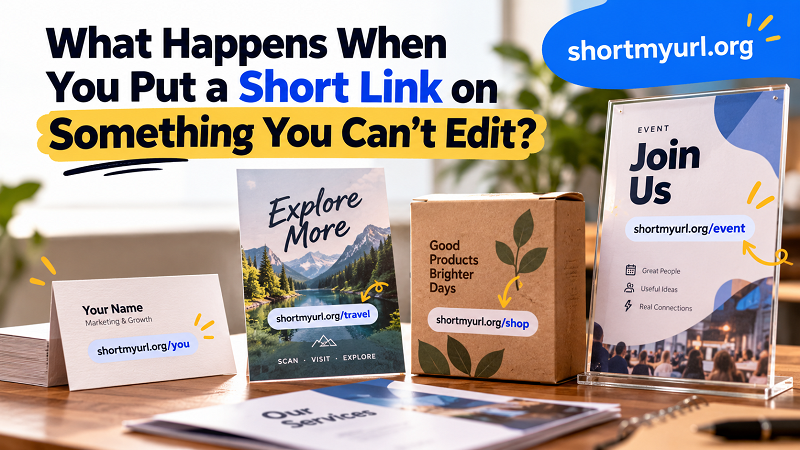
Some Links Live Longer Than the Campaign
Digital content is wonderfully flexible. Change a webpage, update a button, replace a destination, and the new version can be live in minutes. Printed material plays by completely different rules. A promotional flyer might be distributed for a few weeks, a business card could stay with someone for years, and product packaging may remain in circulation long after a campaign has ended. The problem is that the URL printed on those materials doesn’t magically change when your website does. A seasonal campaign might end in October while the flyer promoting it is still sitting on a desk in December. If that printed URL leads nowhere useful, the campaign has effectively left a broken door behind. The real issue isn't simply how long the URL is; it’s whether the destination can continue to make sense for as long as the physical material remains in the wild.
A Printed URL Is a Commitment
When you publish a link online, changing it is usually straightforward. When you print one, you are making a much longer commitment. Imagine printing example.com/summer-sale-2026. Six months later, the campaign is over, the promotion has expired, and the website team has moved on to something else. The flyers haven't. This is where a short link can become more useful than its appearance suggests. Instead of printing a destination that is tightly connected to one temporary page, you can use a stable public-facing link and manage where it leads over time when the short-link service supports destination updates. The printed material stays the same while the digital destination can evolve. That separation can be extremely useful when physical marketing has a much longer lifespan than the campaign behind it.
Not Every Link Has the Same Job
A URL in an email and a URL printed on packaging may look identical on screen, but they have very different practical requirements. An email link can be edited before you send the next message. A social post can be replaced. A website navigation menu can be changed whenever your team needs it. Printed links are different. Think about business cards, brochures, posters, menus, event signs, product inserts, packaging, trade-show materials, and other physical marketing assets. Once they are distributed, your ability to correct them drops dramatically. That means a link used in physical marketing should be evaluated not only for where it goes today, but also for how useful it might remain tomorrow.
Try the Five-Year Business Card Test
Here’s a simple test: imagine someone finds your business card five years from now. Would the link still make sense? Maybe the company has redesigned its website. Maybe the original service page has moved. Maybe the person listed on the card has changed roles. Maybe the campaign behind the original URL disappeared years ago. You don’t necessarily need every link to survive five years; that would be overkill for a two-week promotion. But the longer a physical asset is expected to remain in circulation, the more important link longevity becomes. A business card, product package, or permanent sign deserves a different strategy from a temporary event flyer. The key is matching the lifespan of the link to the lifespan of the thing carrying it.
Before You Send It to the Printer, Ask These Questions
Before committing a URL to thousands of physical copies, think beyond today’s campaign. Is the destination likely to change? How long will this material be around? Could the webpage move later? Can someone easily recognize or type the link? Will it still be useful after the campaign ends? Can the destination be updated if circumstances change? None of these questions are particularly complicated, but answering them before printing can save you from the classic “we should have thought about this before ordering 10,000 copies” moment. If the destination is permanent, already concise, and unlikely to change, the original URL may be perfectly fine. If the physical asset will live much longer than the current webpage or promotion, flexibility becomes much more valuable.
Think of the Short Link as the Front Door
A useful way to think about this is to separate the public link from the destination behind it. Your printed material displays one stable address. That address acts like the front door. Behind it, the destination can change as your business, campaign, or website evolves. Today, it might lead to a product launch page. Next month, it could point to the product’s main page. Later, it might direct visitors to a support resource, updated offer, or another relevant destination. The physical material doesn’t need to change just because your digital strategy does. Of course, that doesn’t mean every printed URL should automatically become a short link. If a destination is permanent, already concise, and unlikely to change, there may be no reason to add another layer. The point is to recognize when flexibility is actually worth having.
Short Links Make More Sense When the Physical Asset Has a Long Life
The longer you expect something to remain in the real world, the more carefully you should consider the link printed on it. For temporary campaigns, almost any sensible URL may work. For a business card that someone could keep for years, the equation changes. The same is true for packaging, menus, brochures, permanent signage, and other materials that can outlive the campaign that created them. This is where a simple link strategy can prevent a surprisingly annoying problem: having thousands of physical objects pointing toward a digital destination that no longer exists. A good short link isn’t just about making a URL look cleaner. In the right situation, it can give a physical piece of marketing a more adaptable digital connection.
Print Once. Keep the Door Open.
The best time to think about a printed link is before the design goes to production, not after the boxes arrive. Consider how long the material will survive, whether the destination might change, and whether the link should still make sense after the current campaign is finished. Then choose the approach that gives you enough flexibility without adding unnecessary complexity. Printing a URL is easy. Living with that URL for the next three years is the part worth thinking about. If you’re looking for a simple way to create a more practical link for something you’ll share, print, or distribute, short my url can be part of that workflow. The goal isn’t to shorten everything. It’s to choose links that make sense for the way they’ll actually be used.