Too Many Short Links? How to Manage Them Without the Mess
Creating one short link is easy. Creating twenty is still easy. Creating fifty, one hundred, or several hundred is where things get interesting.
- The Short Link Problem Nobody Talks About
- When "I'll Remember What This Link Is For" Stops Working
- Give Your Short Links a Naming Strategy
- Separate Links by Purpose, Not Just by Destination
- Don't Create a New Short Link Just Because You Can
- Build a Simple Link Cleanup Habit
- Keep the Original Destination in Mind
- What If You Are Starting From Zero?
- A Little Organization Goes a Long Way
At first, every link has a clear purpose. One is for a blog post, another is for a product page, another goes into an email campaign, and another is printed on a flyer. Then a few months pass. Suddenly, you are staring at a list of short URLs wondering which one belongs to which campaign.
This is a surprisingly common problem. The challenge is no longer creating short links. It is remembering what all those links are supposed to do.
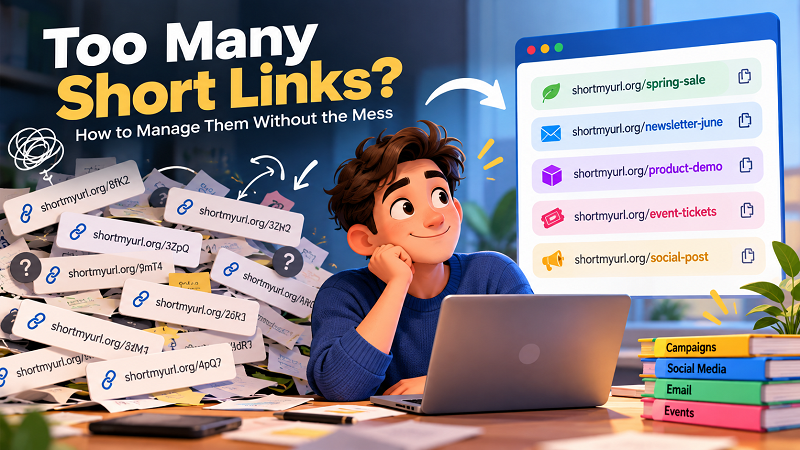
The Short Link Problem Nobody Talks About
URL shorteners are usually discussed from the perspective of creating and sharing links. That makes sense when you are dealing with one or two URLs.
But link collections tend to grow quietly.
You create a short link for a new article. Then another for a promotion. Then one for an email newsletter. A few weeks later, you create another version for social media. Before long, your account contains a pile of links with names that made perfect sense when you created them but are almost meaningless today.
A short URL such as shortmyurl.org/x7Kp2 may work perfectly, but six months later, it tells you almost nothing about its destination.
That creates a different kind of digital clutter.
When "I'll Remember What This Link Is For" Stops Working
Human memory is excellent at many things. Maintaining a perfect mental database of every link created over the last twelve months is not one of them.
This becomes especially obvious when several links point to similar pages.
Imagine you have created short links for:
- A spring promotion
- A summer promotion
- A newsletter campaign
- A Facebook post
- A printed brochure
- A temporary landing page
- A product launch
If the short links are random strings, you may need to open each one just to discover where it leads. Multiply that by dozens of URLs and a simple link-management task starts eating up your time.
The problem is not that short links are bad. The problem is that a growing collection needs some structure.
Give Your Short Links a Naming Strategy
If your shortener supports custom aliases, use them deliberately.
Instead of creating completely random identifiers for every campaign, develop a simple naming pattern that future-you can understand.
For example:
/spring-sale
/newsletter-june
/product-demo
/event-tickets
/summer-launch
You do not need a complicated naming system. In fact, complicated systems often become another problem to maintain. The goal is simply to make the purpose recognizable without having to open the destination.
A good alias should answer at least one basic question: "Why does this link exist?"
If the answer is obvious from the name, you have already made future maintenance easier.
Separate Links by Purpose, Not Just by Destination
Two short links can point to the same website page and still have completely different jobs.
For example, a business might send visitors to the same product page from an email campaign, a printed poster, and a social media post. Creating separate links for each channel can make sense when you need to distinguish how those links are being used.
The important part is keeping that distinction understandable.
Instead of thinking only about the destination, think about the context:
Where will this link appear? Who will use it? Why was it created?
That simple shift can prevent a lot of confusion later.
Don't Create a New Short Link Just Because You Can
There is another trap hiding here: link duplication.
You may already have a perfectly good short URL pointing to a page, but then create another one because you forgot the first link existed.
Now you have two short URLs serving essentially the same purpose.
Do that repeatedly and your link collection becomes harder to understand. You may also end up using different versions of what should have been one consistent link.
Before creating a new short URL, take a second to ask:
Do I already have a link for this purpose?
That tiny pause can save you from building an accidental collection of duplicates.
Build a Simple Link Cleanup Habit
You do not need to spend your Sunday afternoon conducting a forensic investigation into every URL you've ever created.
A lightweight cleanup routine is enough.
Every few months, look through your short links and identify anything that is no longer useful. Old event campaigns, expired promotions, abandoned projects, and temporary pages are obvious candidates for review.
For links you still use, make sure the name or description still makes sense. For links you no longer need, decide whether they should remain available for historical or existing materials.
The key is consistency. Link management works much better as a small recurring habit than as a giant cleanup project you keep postponing.
Keep the Original Destination in Mind
A short URL is only one layer of the link.
Behind it is the actual destination, and that destination can change over time.
A campaign page may disappear. A product URL may be redesigned. A blog post may move to a new address. A temporary landing page may eventually be removed.
This is why link management should not stop at naming short URLs. When reviewing older links, check whether the destination is still relevant and whether the short link is still being used anywhere important.
This is particularly useful for printed materials. A poster or business card can remain in circulation much longer than expected. If an old short URL appears on thousands of physical copies, replacing the destination may be much easier than replacing every printed item.
What If You Are Starting From Zero?
If your collection is still small, now is the perfect time to create a system.
You do not need spreadsheets with seventeen columns or an elaborate naming convention. Start with three basic rules:
First: give important links recognizable names.
Second: avoid creating duplicate links for the same purpose.
Third: review old links occasionally instead of letting them accumulate forever.
For everyday use, you can also shorten website address only after deciding where the link belongs and how you will recognize it later. The goal is not to create as many short URLs as possible. It is to create links that remain understandable and useful after the excitement of the original campaign is long gone.
A Little Organization Goes a Long Way
There is a funny thing about digital clutter: it rarely feels like clutter while you are creating it.
One file is fine. One bookmark is fine. One short link is fine.
The problem appears later, when there are hundreds.
Short links are supposed to make sharing easier, but a badly organized collection can create its own layer of friction. The solution is not complicated software or an elaborate productivity system. A clear naming habit, some basic context, and occasional cleanup can go surprisingly far.
Think of your short links like keys on a keyring. One or two are easy to recognize. Add twenty identical-looking keys and suddenly you are standing outside the door trying every key except the right one.
A little labeling at the beginning saves a lot of guessing later.