How to Share Long Links Without Looking Spammy
A link can say a lot before anyone clicks it.
- Why Do Long URLs Look Unprofessional?
- Long Links Can Get In the Way of Your Message
- Social Media Is One of the Most Obvious Use Cases
- Email Links Don't Always Need to Show the Full URL
- What About Tracking Parameters?
- Short Links Can Be Easier to Trust—If They're Used Properly
- When Should You Shorten a Link?
- When Should You Keep the Original URL?
- How to Create a Cleaner Shareable Link
- A Simple Rule: Optimize the Link for the Person Receiving It
- The Bottom Line
A clean, recognizable URL feels easy to share. A huge string of letters, numbers, tracking parameters, and random characters can have the opposite effect. Even when the destination is perfectly legitimate, a long URL may look messy, difficult to understand, or—let’s be honest—a little suspicious.
This matters more than it might seem. Links are shared everywhere: in emails, social media posts, text messages, newsletters, presentations, printed materials, and customer communications. When the URL itself takes up half the screen, it can distract from the message you're actually trying to send.
The good news is that you don't need to redesign your entire website to make your links easier to share. In many situations, a shorter link is all you need.
Why Do Long URLs Look Unprofessional?
Modern websites often generate long URLs for perfectly legitimate reasons.
An online store might include product categories, product names, filters, and tracking parameters. A marketing campaign might add UTM parameters to measure where visitors come from. A search result can contain a long query string. And some websites simply use complicated URL structures behind the scenes.
The problem isn't necessarily the URL itself. The problem is how it looks when someone sees it outside the website.
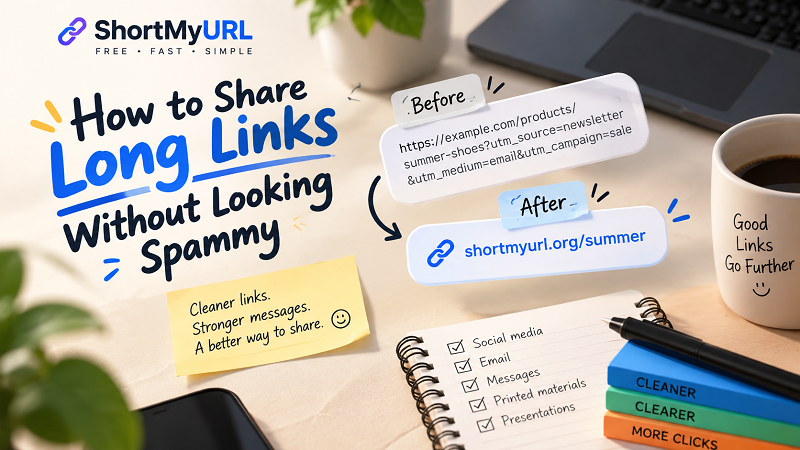
Compare these two examples:
https://example.com/products/category/summer/shoes?utm_source=newsletter&utm_medium=email&utm_campaign=summer-sale
and:
https://short.example/summer
The first URL contains useful information for systems and analytics, but it's not particularly pleasant to read or share. The second is much easier to recognize and communicate.
That doesn't mean every long URL is bad. It simply means that the best URL for a website's internal structure isn't always the best URL for sharing.
Long Links Can Get In the Way of Your Message
Imagine sending someone a short message that says:
Check out this guide for our upcoming event.
Then you paste a URL that's three lines long.
Suddenly, the link becomes the most visually prominent part of the message.
This is especially noticeable in email newsletters, social media captions, chat messages, and mobile devices. Long URLs can wrap across multiple lines, make messages harder to scan, and take attention away from the actual call to action.
A shorter link keeps the focus where it belongs: on the content you're sharing.
Social Media Is One of the Most Obvious Use Cases
Social media posts already compete for attention. You have limited space, a headline or caption, an image or video, and potentially a call to action.
A long URL can make the whole post feel cluttered.
Short links are particularly useful when you want to share a specific article, product page, event registration page, or campaign landing page without displaying a complicated web address.
They're also easier to copy and paste when someone wants to share your link with another person.
That said, don't shorten every link automatically. If the original URL is already short, recognizable, and trustworthy, keeping it visible may actually be better.
Email Links Don't Always Need to Show the Full URL
Email is another place where long URLs can become distracting.
For example, instead of displaying a long campaign URL directly in an email, you can use descriptive text such as View the event details and attach the destination to that text.
But there are situations where you actually want the URL to be visible—especially when you're asking someone to copy it, type it manually, or share it elsewhere.
That's where a short URL becomes useful.
A compact link is easier to recognize and less likely to dominate the email visually.
What About Tracking Parameters?
This is one of the biggest reasons modern URLs become extremely long.
Marketing platforms commonly use parameters such as:
- utm_source
- utm_medium
- utm_campaign
- utm_content
These parameters help marketers understand where traffic comes from and which campaigns generate clicks.
For example:
https://example.com/guide?utm_source=facebook&utm_medium=social&utm_campaign=fall_campaign
The tracking information may be valuable to the website owner, but it doesn't necessarily need to be the most visible part of the link shared with an audience.
A URL shortener can provide a cleaner public-facing link while allowing the destination URL to retain its parameters.
For marketers, this can be a simple way to make campaign links easier to share without abandoning useful tracking data.
Short Links Can Be Easier to Trust—If They're Used Properly
There's an important distinction here.
A short URL isn't automatically trustworthy simply because it's short.
In fact, completely unfamiliar shortened links can sometimes make people cautious because the destination isn't immediately obvious. That's why the context surrounding a link matters.
If you're sharing a shortened link, make the destination clear through your surrounding text.
Instead of:
Click here: short.link/8xK92
Try:
Read our guide to preparing for your next event: short.link/event-guide
Even better, if your URL shortener supports custom aliases, use a meaningful alias that gives people some idea of where the link leads.
The goal isn't to hide the destination. It's to make the link easier to manage and share.
When Should You Shorten a Link?
There are a few situations where shortening makes particular sense.
If you're sharing a URL through social media, messaging apps, email, or printed materials, a shorter link can make the content cleaner and easier to communicate.
It's also useful when a URL contains tracking parameters or other technical information that isn't relevant to the person receiving the link.
Printed materials are another good example. A long URL on a poster, flyer, business card, or presentation slide is difficult to read and even more difficult to type correctly.
A short, memorable URL can work much better.
When Should You Keep the Original URL?
Shorter isn't always better.
If you're sharing a well-known domain with a simple path, the original URL may provide more context and trust.
For example, a recognizable URL such as:
example.com/pricing
doesn't really need to be shortened.
The same applies when the full URL is important for transparency or when users need to see exactly where a link leads.
The goal should be useful and appropriate links, not the shortest possible links.
How to Create a Cleaner Shareable Link
If you frequently deal with long URLs, the process can be very simple.
First, copy the complete destination URL. Make sure it points to the correct page before doing anything else.
Then use a URL shortening service to create a compact version. If the service supports custom aliases, consider using a short, meaningful name rather than a random collection of characters.
Before sharing the new link, test it yourself.
Open it in a private browser window or another device and make sure it redirects to the intended destination. This small step can prevent an embarrassing broken-link situation later.
If you're managing campaigns or business links, keeping track of which short URL points to which destination can also save time later.
A Simple Rule: Optimize the Link for the Person Receiving It
It's easy to think about URLs from the website owner's perspective.
Developers think about URL structures. Marketers think about tracking parameters. Analytics teams think about attribution.
But the person receiving the link has a much simpler question:
Can I understand this link, trust it, and share it easily?
That's the perspective worth considering.
If the original URL is already short and meaningful, leave it alone.
If it's long, complicated, filled with tracking parameters, or awkward to communicate, shortening it can make the experience much cleaner.
And if you're constantly thinking, “I need to short my url before I send this,” an online URL shortener such as ShortMyURL.org can turn that extra-long address into a much more manageable link in a few seconds.
The Bottom Line
Long URLs aren't inherently a problem. In many cases, they're simply a byproduct of how modern websites, analytics systems, and marketing platforms work.
The problem starts when that technical URL becomes the thing your audience has to read, copy, remember, or share.
A good short link doesn't change where the visitor goes. It simply makes the journey to that destination cleaner.
So before sending your next link, take a second look at it. If it's already simple, keep it. If it looks like a paragraph of code, shortening it might be the easiest improvement you can make.
Sometimes, making a link better really is that simple.