Your Portfolio Is Strong. Are Your Links Getting in the Way?
You've spent weeks polishing your portfolio. The projects look sharp, the case studies show off your skills, and your resume finally says what you actually bring to the table. Then you send your application, and the hiring manager opens an email containing seven unexplained links, three suspiciously long URLs, and a portfolio buried somewhere between your LinkedIn profile and a PDF nobody asked for.
- Great Projects Deserve Better Introductions
- Give Every Link a Purpose
- Clean Up the Clicks Without Overcomplicating Things
- Make the Recruiter's First Five Minutes Count
- Your Portfolio Should Work as Hard as You Do
That's not exactly the first impression you had in mind.
Your work might be excellent, but people need a straightforward way to discover it. A portfolio isn't just a collection of things you've made. It's a guided introduction to how you think, what you can do, and why someone should want to work with you. If navigating your links feels like a scavenger hunt, you're making the reader work harder than necessary.
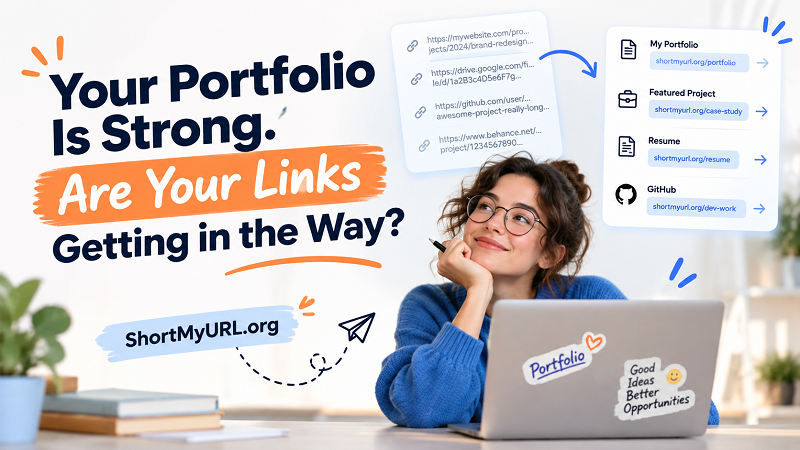
Great Projects Deserve Better Introductions
Imagine a recruiter reviewing dozens of applications between meetings. They don't have an unlimited amount of time to investigate every candidate, and they shouldn't need a map to find your best work. When your email contains a long list of links with no explanation, the recruiter has to guess which one matters most, what each destination contains, and where to start.
Now imagine a different experience. Your message opens with a concise introduction, followed by your portfolio, two relevant projects, and your professional profile. Each link has a clear label, and the order reflects the position you're applying for. Suddenly, the recruiter can understand your work without decoding your email first.
The difference isn't about making your portfolio look fancy. It's about removing unnecessary friction. A graphic designer applying for a branding role should lead with identity projects, not an unrelated collection of social media graphics. A developer seeking a backend position should make relevant repositories or technical case studies easy to find. A writer pitching for content work should put strong writing samples front and center. Your most relevant work deserves the best seat in the room.
Give Every Link a Purpose
Before changing a single URL, decide what you want each link to accomplish. Think of your application as a short presentation rather than a digital storage box. Every destination should answer a question the recruiter is likely to have.
Your main portfolio establishes the bigger picture. A standout project demonstrates your ability to solve a specific problem. Your resume summarizes your experience, while your professional profile provides additional context. You don't necessarily need all four in every application, but if you include them, make sure each one adds something useful.
Context matters just as much as selection. Compare a bare link labeled "Project 01" with a short description such as "E-commerce redesign focused on simplifying checkout." The second option gives the reader a reason to click before they even open the page. You can use this principle in your email, portfolio navigation, project descriptions, and downloadable documents.
Most importantly, tailor the selection to the opportunity. Sending the same generic bundle of links to every employer might save a minute during preparation, but it can make your application feel disconnected from the role. You don't need to rebuild your entire portfolio for every application. A little thoughtful editing can make the right projects stand out.
Clean Up the Clicks Without Overcomplicating Things
Once your portfolio structure makes sense, look at the links themselves. Some URLs are naturally long because they contain nested paths, project identifiers, or tracking parameters. That isn't automatically a problem when someone clicks a link on a webpage, but it can become awkward in an email, a printed resume, a presentation, or a message with limited space.
This is where a short url generator can be useful. It lets you turn a lengthy destination into a more compact link that's easier to share in places where space and readability matter. Instead of pasting an intimidating string of characters into an application email, you can present a cleaner link that fits more naturally into your message.
Keep the destination relevant and the label descriptive. A short URL doesn't tell a recruiter what they'll find on the other side, so don't rely on the shortened address alone to explain your work. Pair it with a clear description, and make sure the destination opens the intended project rather than a generic homepage.
There's also a practical reason to be selective. Recruiters may hesitate before clicking unfamiliar links, particularly when reviewing applications from people they haven't met. Use a trustworthy domain, avoid disguising where a link leads, and provide enough context for the reader to make an informed decision. A cleaner URL should improve the experience, not make the destination more mysterious.
Make the Recruiter's First Five Minutes Count
You don't control how much time a recruiter spends reviewing your application, but you can influence how quickly they find the information they need. Try reviewing your portfolio from the perspective of someone who has never seen your work before. Open the link on a phone, skim the first screen, and ask yourself whether your strongest project is immediately obvious.
Check the practical details, too. Do the links open correctly? Are any project pages restricted by permissions? Does a supposedly finished case study still contain placeholder text? If you've included a PDF, is it readable on a smaller screen? A beautiful portfolio that requires a login nobody can access isn't doing you any favors.
Pay attention to what happens after the click. If a project takes visitors to an outdated version, a broken page, or a landing page that doesn't match the link description, the presentation loses credibility. Review important destinations whenever you update your portfolio, and remove links that no longer serve a clear purpose.
Finally, resist the temptation to include every project you've ever completed. More work doesn't automatically make a stronger impression. A smaller, carefully selected collection can communicate your strengths more effectively than a sprawling archive that forces the reader to figure out what's important.
Your Portfolio Should Work as Hard as You Do
A strong portfolio doesn't need elaborate tricks, dozens of links, or a complicated presentation. It needs a clear story, relevant examples, and a path that helps people discover your best work without unnecessary detours. The goal is to make your skills easier to evaluate, not to give recruiters another task to complete.
Take a few minutes to review your next application before sending it. Put the most relevant project first, explain what each link contains, remove anything that creates confusion, and test the destinations. If a URL is unnecessarily long, make it easier to share without sacrificing clarity or trust.
You've already done the hard work of building something worth showing. Now make sure the way you share it gives that work a fair chance to shine.