What Happens If Your URL Shortener Shuts Down?
You’ve spent months sharing links across social media, email campaigns, printed flyers, product packaging, and customer documents. Some have collected thousands of clicks. Others have become permanent fixtures in old blog posts or QR codes scattered around the real world. Then, one morning, your URL shortening service disappears.
- A Short Link Depends on More Than Its Destination
- The Real Cost of Losing Your Short Links
- Marketing campaigns can lose their landing pages
- Printed materials can become expensive mistakes
- Old content can quietly become a source of broken traffic
- Historical data may be difficult to recover
- Not Every Link Deserves the Same Level of Protection
- Build a Backup Plan Before You Need One
- 1. Keep a record of original destinations
- 2. Record where each link has been published
- 3. Decide how replacement would work
- 4. Review the provider's policies and capabilities
- 5. Test important links periodically
- Questions to Ask Before Choosing a URL Shortener
- A Practical Continuity Plan for Your Links
- Don't Let One Service Become a Single Point of Failure
Now what?
The destination websites might still be online. Your content might be perfectly fine. But if the service responsible for redirecting visitors to those destinations stops working, your carefully distributed short links could become dead ends. And unlike a typo in a new social media post, a broken link printed on 5,000 product labels isn't something you can fix with a quick edit.
A URL shortener shutting down might sound like a remote possibility, but it raises a practical question for anyone who depends on links: What happens to everything you've already shared, and how do you avoid putting your business at the mercy of a single service?
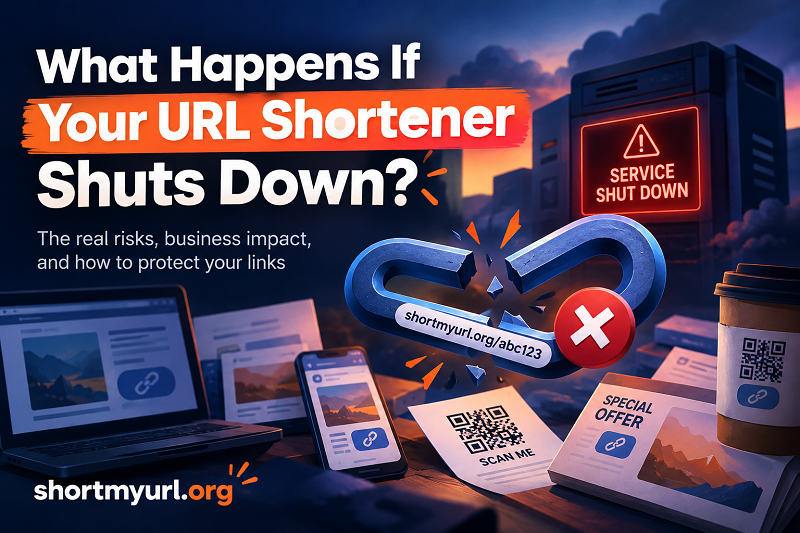
A Short Link Depends on More Than Its Destination
A shortened URL isn't simply a smaller version of a long address. It's an entry point managed by an intermediary.
When someone clicks a short link, the shortening service receives the request, identifies the destination associated with that short code, and redirects the visitor. The process usually happens in seconds, so users rarely think about the infrastructure working behind the scenes.
That dependency matters. If the shortening service experiences an outage, loses its redirect data, suspends an account, or permanently closes, the redirect may stop working even when the original destination remains available.
Consider a simple example. Your original page lives at https://example.com/products/summer-collection, but you've distributed a shorter address across several marketing channels. People now use the short address rather than the original URL. If the redirect stops functioning, visitors may never reach the product page.
There is an important distinction here: a service outage, an individual link problem, and a permanent shutdown are not the same thing. A temporary outage may resolve itself. A disabled link might be recoverable through support. A permanent closure, however, could leave you without a way to restore the redirects you once relied on.
The exact outcome depends on the provider's infrastructure, policies, data retention practices, and shutdown arrangements. Some services may offer migration options or advance notice. Others may provide limited recovery options. Never assume that every provider handles the situation in the same way.
The Real Cost of Losing Your Short Links
The biggest risk isn't always the number of broken links. It's where those links live, how many people depend on them, and whether you can replace them.
Marketing campaigns can lose their landing pages
Imagine launching a seasonal campaign with short links in advertisements, newsletters, influencer posts, and promotional materials. The campaign performs well, and those links remain in circulation long after the initial launch.
If the shortening service stops redirecting, visitors can encounter errors instead of your landing page. Paid campaigns may continue generating impressions while the intended customer journey breaks down. Older posts can keep sending people toward a destination they can no longer reach through the original link.
The result isn't merely an ugly URL. It's a gap between your marketing effort and the experience your audience expects.
Printed materials can become expensive mistakes
Digital content is relatively easy to edit. Printed content is another story.
A short link on a business card, product label, event banner, restaurant menu, instruction manual, or promotional flyer can remain in use for months or years. Once the material has been distributed, changing the destination may be impossible without reprinting it.
QR codes deserve particular attention. A QR code that contains a short URL still depends on that URL's redirect service. The code itself may remain perfectly readable while the destination becomes inaccessible.
This is why links embedded in physical materials deserve more attention than temporary links shared in a post you can edit tomorrow.
Old content can quietly become a source of broken traffic
Not every valuable link belongs to an active campaign. Some live in blog articles, archived newsletters, partner websites, customer support documents, or presentations that continue circulating long after publication.
These links can be easy to overlook because nobody is actively managing them. You might not discover a problem until a customer reports it, an analytics report shows an unexpected decline, or a routine review reveals that an important resource is no longer reachable.
The longer a link remains in circulation, the more important it becomes to know where it was published and what it was supposed to do.
Historical data may be difficult to recover
Depending on the service, you might lose access to click statistics, campaign comparisons, custom aliases, or other management information. Even if you can reconstruct the original destinations, recreating your historical reporting may be difficult or impossible.
For teams that use link analytics to compare campaigns, this can complicate performance reviews. A replacement link might restore access to the destination, but it won't necessarily restore the historical data associated with the old one.
Keep an independent record of important campaign information rather than treating a provider's dashboard as your only source of truth.
Not Every Link Deserves the Same Level of Protection
Trying to monitor every short URL with equal intensity is a recipe for wasted time. A better approach is to prioritize links according to their business impact and how difficult they would be to replace.
| Link category | Risk level | Why it matters |
|---|---|---|
| Payment, booking, registration, or conversion links | Critical | A failure can interrupt an active business transaction |
| QR codes on packaging and printed materials | High | Replacing the published material may be expensive or impractical |
| Links in evergreen articles and long-term resources | High | They can continue attracting visitors long after publication |
| Links in active email and advertising campaigns | High | A failure can disrupt an ongoing customer journey |
| Temporary event links and short-lived promotions | Medium | Their value depends on whether the event or offer is still active |
| Expired experiments and obsolete internal references | Low | They may no longer require ongoing maintenance |
These categories are starting points, not universal rules. A link to a small event could be critical if it controls access to paid tickets. An old article link might be low priority if the page no longer receives meaningful traffic.
The practical question is simple: If this link stopped working today, how much damage would it cause, and how difficult would recovery be?
Start with the links that support revenue, customer access, and materials you cannot easily change. Build your protection plan around those first.
Build a Backup Plan Before You Need One
A backup plan doesn't mean maintaining a complicated spreadsheet for every URL you've ever shared. It means keeping enough independent information to recover your most important links without relying entirely on the service that created them.
1. Keep a record of original destinations
For each important short link, record its full destination URL, intended purpose, publication location, and owner. Include the date it was created if that information helps with maintenance.
A simple spreadsheet is often enough. For larger operations, a centralized link inventory can make it easier to search, assign responsibility, and identify links that support active campaigns.
The key is independence. Store the inventory somewhere separate from the shortening service so that losing access to the service doesn't also mean losing your recovery records.
2. Record where each link has been published
Knowing the destination is only half the job. You also need to know where the short link appears.
Was it included in a newsletter? Printed on packaging? Added to an influencer's profile? Embedded in a downloadable PDF? Shared with a distribution partner?
Record the channels that matter most and whether you can edit them. This information helps you estimate the effort required to replace a link and identify situations where replacement isn't realistically possible.
You don't need perfect documentation from day one. Start with high-impact links and expand the inventory as part of your normal publishing process.
3. Decide how replacement would work
If a provider becomes unavailable, what would your team do first?
For editable digital content, you might replace the old short URL with a direct destination URL or a new short link. For QR codes already printed on physical materials, the options may be much more limited. You might need a replacement sticker, a revised print run, or an alternative communication channel.
Create a simple recovery procedure before an incident occurs. Identify who can update each channel, where the source files are stored, and how the team will communicate changes to customers or partners.
A plan that exists only in someone's head is not much of a plan.
4. Review the provider's policies and capabilities
Before committing important links to a service, look beyond how quickly it generates a short URL.
Check the provider's terms of service, link retention policies, data export options, account recovery procedures, support channels, and any published information about service continuity. Determine whether links can be managed or exported in bulk and whether the service explains what happens if operations are discontinued.
Also distinguish between a promise that links won't expire under normal conditions and a guarantee that the service itself will remain operational indefinitely. Those are very different things.
No provider can honestly eliminate every possible operational risk. The goal is to understand the dependency and make a decision that fits the importance of your links.
5. Test important links periodically
A link that worked when you created it may not work forever. Destinations can change, accounts can be suspended, and redirect configurations can be modified.
Schedule periodic checks for your highest-priority links. Confirm that each short URL redirects to the intended destination, that the destination is accessible, and that the resulting page still serves its purpose.
For businesses with large link inventories, automated monitoring may help. For smaller projects, a regular manual review can be a reasonable starting point.
Testing won't prevent a provider from shutting down, but it can reveal problems early and confirm that your recovery records are still useful.
Questions to Ask Before Choosing a URL Shortener
Choosing a shortening service is partly a usability decision and partly a decision about long-term dependency.
When evaluating a web url shortener, consider the following questions:
- What happens if the service experiences an outage? Look for clear information about service availability and support.
- Can I export or independently record my link data? Make sure you can retain the destination URLs and other important information outside the provider's dashboard.
- Are links permanent under the stated service terms? Understand the conditions, exceptions, and limits of any permanence claims.
- Can I manage important links efficiently? Bulk management, search, custom aliases, and analytics may matter as your link inventory grows.
- What happens if I lose access to my account? Review account recovery procedures and whether you can maintain appropriate administrative access.
- Can I change links already distributed to the public? Understand which redirect settings are editable and which changes may require a new URL.
A free service can be perfectly suitable for many workflows. A paid plan isn't automatically safer, and a long feature list doesn't guarantee continuity. Evaluate the actual policies and capabilities rather than assuming price determines reliability.
For business-critical links, consider whether your team needs additional controls, a documented recovery process, or a provider arrangement designed around its operational requirements.
A Practical Continuity Plan for Your Links
You don't need to wait for a shutdown announcement to make your link strategy more resilient. Use three stages to turn preparation into a manageable routine.
Now: identify your most valuable links. List the short URLs used in active campaigns, printed materials, customer transactions, and long-lived resources. Record their original destinations and where they appear. Give priority to links that would be expensive or difficult to replace.
Regularly: verify and update your records. Test critical redirects, check destination pages, update the inventory when links change, and review whether the provider's policies or capabilities have changed. Make sure the people responsible for maintaining your links know where the recovery information lives.
If a shutdown or serious outage occurs: assess before rebuilding. Check official provider announcements and determine whether the problem is temporary. Avoid creating duplicate replacements prematurely if the original service may recover. If the shutdown is confirmed, use your inventory to prioritize essential links, update editable channels, and communicate any unavoidable changes.
Remember that a new short URL does not automatically replace an old one everywhere it has been published. You can update a website you control, but you generally cannot rewrite a printed QR code or edit an old post on someone else's account. Those limitations should shape your recovery plan from the beginning.
Don't Let One Service Become a Single Point of Failure
Short links make sharing easier, but convenience should not come at the expense of basic preparation. The more places a link appears, the more valuable it becomes to understand its destination, its purpose, and your options if the redirect stops working.
You don't have to assume every URL shortening service will disappear. You simply need to avoid building a system in which one unexpected outage can disrupt your most important customer journeys.
Keep independent records, prioritize the links that matter, review provider policies, and plan how you'll respond if a service becomes unavailable. These steps won't eliminate every risk, but they can make the difference between a manageable disruption and a costly scramble.
Your links may be short. Your backup plan shouldn't be an afterthought.