The Anatomy of a Good Short URL: What Makes One Worth Clicking?
Shorter isn't always better.
- Short Doesn't Automatically Mean Good
- Think of the Link as a Tiny Interface
- 1. Readability Beats Randomness When People Need Context
- 2. Memorability Is More Than Having Fewer Characters
- 3. Don't Make the Alias Longer Than the Problem
- 4. Consistency Can Make Links Easier to Recognize
- 5. Don't Make People Guess What They're Clicking
- 6. The Surrounding Message Matters Too
- 7. A Beautiful Link Can Still Point to the Wrong Place
- The Five-Second Test
- Random Codes Aren't the Enemy
- When the Shortest Link Isn't the Best Link
- Build Links for Humans, Not Just Browsers
That sounds slightly strange when we're talking about links. After all, the whole point of shortening a URL is to make it… well, shorter. But if you've ever received a tiny link that looked like a random pile of letters and numbers, you already know the problem: a link can be compact and still be terrible to use.
A good shortened link should do more than save characters. It should make the next step feel simple.
Can people read it? Can they remember it? Does it look intentional? Does it give them enough confidence to click?
Those little details can make the difference between a link that simply exists and one that people are actually comfortable using.
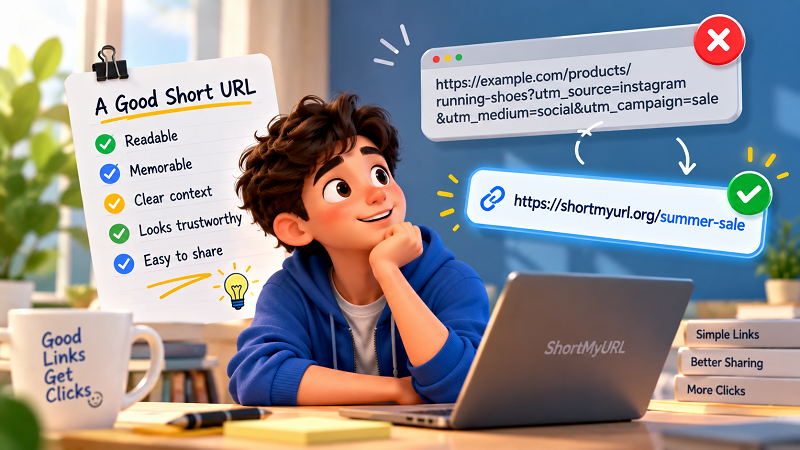
Short Doesn't Automatically Mean Good
Let's start with an uncomfortable truth: you can make almost any URL shorter.
That part is easy.
The harder part is deciding what the shorter version should look like.
Compare these two examples:
shortmyurl.org/x7K4p
and:
shortmyurl.org/summer
The first is compact. The second is compact and communicates something.
If you're sending the link to someone once in a private message, the random version might be completely fine. If you're putting the link on a poster, mentioning it during a presentation or expecting people to remember it later, the second version has an obvious advantage.
The number of characters is only one measurement.
The real question is whether those characters are useful.
Think of the Link as a Tiny Interface
People often treat URLs as purely technical objects. Browsers need them, servers process them and websites depend on them.
But users see them too.
Before clicking, someone might glance at a link and make a split-second judgment:
“Does this look right?”
“Is this what I was expecting?”
“Can I tell where this goes?”
“Could I type this manually if I had to?”
That's why a link is also a tiny piece of user interface.
It has a visual appearance. It creates expectations. And, whether we like it or not, it can influence how comfortable someone feels about clicking.
You don't need to turn every link into a marketing masterpiece. Just don't forget that humans have to interact with it.
1. Readability Beats Randomness When People Need Context
Imagine you're sharing a link to a summer promotion.
This:
shortmyurl.org/a9F2x
does the job.
But this:
shortmyurl.org/summer-sale
does something extra. It gives the reader a tiny piece of context before the click.
That's useful when the link is visible in a public-facing environment.
A descriptive alias can help people connect the link with the content they're expecting to find. It can also make the address easier to communicate verbally.
Of course, not every link needs a descriptive name. A random code can be perfectly appropriate when you're creating a one-off link or when the destination doesn't need an explanation.
The point isn't that meaningful aliases are always superior.
It's that context has value.
2. Memorability Is More Than Having Fewer Characters
Here's a fun little test.
Look at a link for three seconds. Close your eyes. Can you remember any of it?
A random string is usually difficult to retain:
shortmyurl.org/Q8n4Zp
A recognizable word or phrase is much easier:
shortmyurl.org/event
This becomes especially important when the link appears outside a normal clickable interface.
Maybe you're speaking to an audience.
Maybe the link is printed on a card.
Maybe someone sees it on a screen and plans to enter it later.
In those situations, memorability suddenly matters.
A link doesn't have to be ridiculously clever. In fact, trying too hard can backfire. A simple, relevant word is often more useful than a complicated abbreviation that only makes sense to the person who created it.
3. Don't Make the Alias Longer Than the Problem
Custom aliases are useful, but there's a trap here.
People sometimes take a perfectly good shortened link and then create an alias that is almost as long as the original URL.
For example:
shortmyurl.org/summer-running-shoes-discount-for-members
Congratulations. You've technically created a shortened link, but you've also missed the point.
An alias should be meaningful without becoming a sentence.
Think of it as a label, not a description.
Something like:
shortmyurl.org/running-sale
communicates enough without asking the reader to process a paragraph before clicking.
The sweet spot is usually somewhere between completely random and ridiculously descriptive.
4. Consistency Can Make Links Easier to Recognize
If you're creating multiple links for the same project, consistency can be surprisingly powerful.
Imagine a business running several campaigns:
shortmyurl.org/summer
shortmyurl.org/winter
shortmyurl.org/backtoschool
There is a visual pattern.
Now compare that with a collection of unrelated strings:
shortmyurl.org/K8f3
shortmyurl.org/7LmQ
shortmyurl.org/P2x9
Nothing is technically wrong with the second group. But the first group gives users a mental framework.
They can recognize the naming pattern.
This can be particularly helpful when an organization creates lots of links over time. Consistent naming makes the collection feel intentional rather than accidental.
You don't need a complicated naming system. Even a simple rule can help: campaign name, product name, event name or another short identifier.
5. Don't Make People Guess What They're Clicking
A link doesn't have to reveal its entire destination.
But there is a difference between not revealing everything and looking completely mysterious.
Consider receiving this message:
Check this out: shortmyurl.org/F7k2X
You have almost no context from the link itself.
Now imagine:
Here's the registration page: shortmyurl.org/register
The second version gives you an immediate clue.
This matters because clicking a link involves a tiny amount of trust.
People are more comfortable when the surrounding message and the link make sense together.
That doesn't mean a descriptive alias guarantees safety. It doesn't. A malicious or misleading destination can still hide behind a perfectly innocent-looking name.
But clarity is still better than unnecessary mystery.
6. The Surrounding Message Matters Too
Here's something that gets overlooked when people obsess over the URL itself: the link doesn't exist in isolation.
A great link placed next to a confusing message can still create uncertainty.
A basic link placed inside a clear sentence can work perfectly.
Compare:
Click here: [link]
with:
View the full event schedule here: [link]
The second gives the reader a reason to click and tells them what to expect.
So don't expect the link to carry the entire communication burden.
A good shortened address works best when the surrounding text does its part too.
7. A Beautiful Link Can Still Point to the Wrong Place
This one sounds obvious, but it deserves attention because it's incredibly easy to overlook.
You can have the cleanest, most memorable link imaginable.
If it points to the wrong page, it's still a bad link.
Before sharing a shortened address, test it.
Don't rely on memory. Don't assume you copied the right destination. Open the link yourself and check where it goes.
If you're working with a campaign, product page or event registration form, verify the destination after creating the link.
A few seconds of checking is cheaper than correcting a link after hundreds of people have already seen it.
The Five-Second Test
Here's a simple way to judge a shortened link without turning the process into a science project.
Look at it for about five seconds and ask:
Can I read it?
If the characters are confusing or unnecessarily complicated, that's a warning sign.
Can I remember it?
You don't need to memorize every link, but if people are expected to recall it later, this becomes important.
Does it fit the context?
A link for a summer promotion should ideally make sense within the summer promotion. A registration link should look like it belongs to the event.
Does it feel intentional?
There's a difference between a clean, deliberate address and something that looks like a database accidentally escaped onto the internet.
Would I be comfortable sharing it?
This final question is surprisingly useful. If you hesitate before putting the link into a message, there's probably something worth reconsidering.
Random Codes Aren't the Enemy
It's tempting to make this sound like every shortened link should have a clever custom name.
That's not true.
Random characters have their place.
They can keep links compact, avoid conflicts between aliases and work perfectly well when the destination is already explained elsewhere.
If you're sending someone a link with the message:
Here's the document we talked about.
then a random short link may be completely adequate.
The surrounding context does the explaining.
A custom alias becomes more valuable when the link itself needs to carry some meaning.
That's the distinction worth remembering.
When the Shortest Link Isn't the Best Link
We've come full circle.
If you judge a link only by its character count, you'll naturally want to remove everything possible.
But people don't interact with character counts. They interact with links.
A useful link can be slightly longer and still be easier to understand, remember and share.
That's why the goal shouldn't be:
Make it as short as possible.
A better goal is:
Make it as simple as necessary.
Those sound similar, but they're not.
The first encourages you to chase a number. The second encourages you to think about the person using the link.
Build Links for Humans, Not Just Browsers
Browsers don't care whether a URL is memorable.
Servers don't care whether it looks elegant.
Humans do.
That's why the best shortened links sit somewhere between technical efficiency and human communication. They don't need to be flashy. They don't need to explain everything. They simply need to remove unnecessary friction.
If a random code does that, great.
If a short descriptive alias does it better, use one.
And if the original URL is already clean and useful, there's nothing wrong with leaving it alone.
When you create a short url, don't ask only whether you've reduced the character count. Ask whether you've created something that another person can understand, recognize and use without having to think twice.
That's the real anatomy of a good link.