Link Generator Short: Create Better Links for Real-World Sharing
You have the page. You have the URL. You copy it, paste it into a message, and then... stare at a giant string of characters that looks like it belongs inside a database rather than a conversation. The website works perfectly, so what's the problem? Usually, it isn't the destination. It's the way the link has to travel from one person to another.
- The Same URL Can Behave Very Differently Depending on Where You Put It
- Before Shortening a Link, Ask One Simple Question
- Four Situations Where Link Length Suddenly Matters
- When a Long URL Is Actually Fine
- What Makes a Shareable Link Feel Better?
- Don't Turn Every URL Into a Short Link
- The Better Way to Think About Link Creation
A URL can be technically perfect and still be annoying to use. Maybe it contains tracking parameters, a product ID, several folders, or a long campaign string. Maybe you're putting it inside an email where it takes up half the screen. Or perhaps you're trying to print it on a flyer where nobody wants to type twenty-five characters just to visit a webpage. That's where the context of the link suddenly matters more than the link itself.
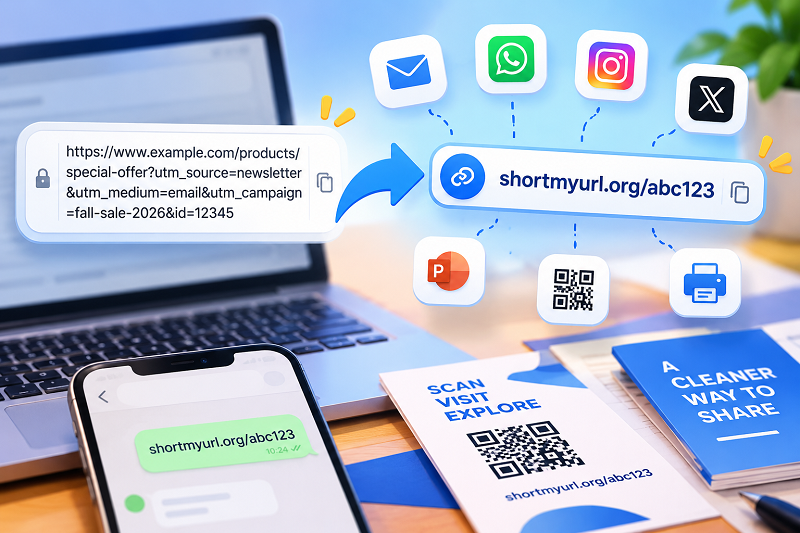
The Same URL Can Behave Very Differently Depending on Where You Put It
Think about the last few links you shared. A URL dropped into a private chat doesn't have the same requirements as one included in a business email. A link inside a presentation needs to look clean. A link on a printed poster needs to be easy enough to type. A URL placed in a social profile has to compete with limited space. The destination might be identical in every case, but the sharing experience isn't.
This is an easy detail to overlook because browsers make URLs feel invisible. You click, the page opens, and everything seems fine. The awkwardness usually appears when you take the URL out of the browser and put it somewhere else.
For casual sharing, a long URL might not matter at all. Send it to a friend in a messaging app and you're done. But when the same address has to be copied into a proposal, sent to dozens of customers, displayed on a screen, or remembered later, unnecessary length starts becoming friction.
Before Shortening a Link, Ask One Simple Question
Will someone have to look at, copy, type, or share this URL?
If the answer is no, leave it alone. There is no prize for turning every URL on your website into a short link.
If the answer is yes, take another look.
A URL with a few readable words may already be perfectly usable. On the other hand, something like a long product URL followed by multiple parameters can become difficult to scan and even harder to communicate verbally. You don't necessarily need to rebuild the website just because one URL is inconvenient to share.
That's an important distinction. Your website's URL structure serves the website. A shareable link serves the person passing the URL around.
Four Situations Where Link Length Suddenly Matters
Email is the first obvious one. Long URLs can make an otherwise clean message look messy, especially when the link contains technical parameters. If you're sending a customer to one specific page, a compact link can make the call to action feel much more intentional.
Chat is different. People move quickly in messaging apps. They copy, paste, forward, and lose old messages. A shorter address is easier to recognize when scrolling through a busy conversation. You can also pair it with a simple sentence instead of dropping an intimidating wall of characters into the chat.
Documents and presentations have their own rules. A URL that works inside a browser may look ridiculous on a slide. You don't want the audience reading a URL instead of paying attention to the presentation. The same applies to proposals, PDFs, reports, and other documents where visual clarity matters.
Print is where long URLs really show their weaknesses. Imagine seeing a website address on a restaurant card, event poster, product package, or small promotional display. Nobody wants to manually enter a complicated string containing random numbers and symbols. A compact URL gives people less to type and fewer opportunities to make a mistake.
When a Long URL Is Actually Fine
Here's the part that often gets skipped in articles about URL shortening: sometimes you shouldn't shorten anything.
If you're sending a useful article to one person, the original URL may be completely acceptable. If the address is short, descriptive, and easy to understand, changing it doesn't automatically make the experience better. Internal website navigation is another example. Your visitors don't need every internal destination wrapped in a shortened address.
There is also value in a readable original URL. Someone can often understand where a link leads simply by looking at it. That transparency can be useful, particularly when the URL structure clearly describes the destination.
The goal isn't shorter at all costs. The goal is appropriate for the situation.
What Makes a Shareable Link Feel Better?
Length is only one piece of the puzzle. A good shareable link should be easy to copy, difficult to mistype, and simple enough to recognize later. If you're creating a custom alias, avoid stuffing it with unnecessary abbreviations or characters that nobody will remember.
It also helps to check the destination before sharing. A beautifully short link that sends someone to the wrong page is still a bad link. Open it yourself, make sure the destination is correct, and then use it where it actually makes sense.
If you're looking for a quick way to create a compact version of a longer destination URL, a link generator short tool can take care of that basic job without forcing you to change the structure of your website.
Don't Turn Every URL Into a Short Link
This might sound slightly counterintuitive, but restraint is useful here.
Your website can have perfectly good long URLs that should remain exactly as they are. SEO-friendly page addresses, internal links, canonical URLs, documentation pages, and other technical parts of a site don't suddenly become better because they're shorter.
Think of a shortened URL as a sharing layer, not a replacement for your website's entire URL structure.
The original URL remains the destination. The shorter version simply gives you another way to get people there when the original address isn't convenient for the environment you're using.
The Better Way to Think About Link Creation
Instead of asking, “How short can I make this URL?” try asking, “Where is this link going next?”
That tiny change in thinking makes the decision much easier. A long URL in a browser may be perfectly normal. The same URL inside a printed advertisement might be a headache. A detailed URL in an internal document might be useful, while the same address sent to a customer may feel unnecessarily complicated.
Links don't exist in isolation. They move between websites, people, apps, documents, screens, and real-world spaces. The best version is often the one that fits the situation rather than the one with the fewest characters.
So before you shorten your next URL, look beyond the destination. Think about the person who will receive it, the place where they'll see it, and what they'll have to do with it. That's usually where the difference between a technically correct link and a genuinely useful one becomes obvious.